
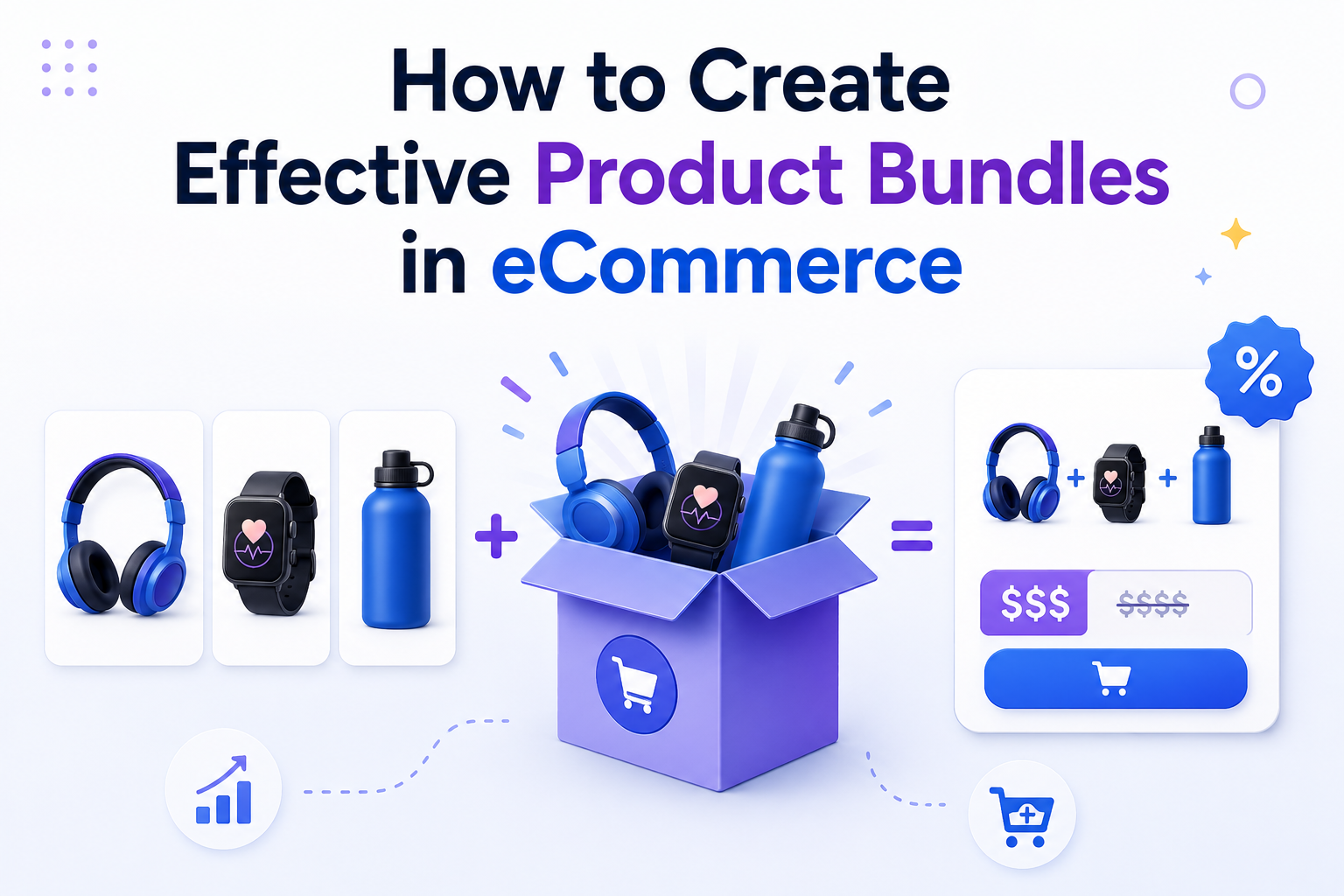
Every eCommerce business owner reaches a point where they ask the same uncomfortable question:
"How do we get customers to spend more per order without just discounting everything?"
Coupons and flash sales have their place. But they erode margins, train customers to wait for the next deal, and don't build any lasting value for your brand. There's a better lever and it's one that some of the world's most profitable eCommerce brands have quietly been using for years.
Product bundling.
Not the kind where you randomly group items together and slap a "bundle deal" label on them. The kind where you think carefully about what your customers actually need, package it in a way that removes their hesitation, and price it so the value is obvious without destroying your margins.
When done right, bundling doesn't feel like a sales tactic. It feels like your store genuinely understood what the customer was trying to accomplish.
Want bundles built into your store?
Whether you're on Shopify, nopCommerce, or WooCommerce our team can build custom bundle logic, recommendation engines, and bundle placement strategies that actually convert.
Talk to our eCommerce team →Why most eCommerce owners overlook bundling
Bundling sounds simple on the surface. Group some products. Add a price. Done. But that's exactly where most stores go wrong they create bundles based on what's convenient for the business, not what's useful for the customer.
A bundle of three slow-moving products nobody wanted individually is not a bundle. It's a clearance sale in disguise, and customers can tell the difference.
Effective bundling starts with understanding what your customers are actually trying to achieve when they come to your store. Are they trying to build an outfit? Stock up on essentials? Find a complete skincare routine? A gift for someone? When you answer that question first, the right bundle combinations become obvious.
The psychology behind why bundles work
Customers shop emotionally first and logically second. Bundles tap into two very reliable psychological triggers that drive purchasing behaviour.
Perceived value
People want to feel like they're getting more for their money even if the total spend is actually higher than they originally planned. When a bundle is priced smartly and the combination is clearly relevant, the perceived saving becomes its own reason to buy. The customer isn't doing detailed margin math. They're feeling like they made a smart choice.
Reduced decision fatigue
A customer browsing 60 individual products might hesitate for minutes before choosing anything. But show them a curated "Weekend Casual Bundle" shirt, jeans, belt, already selected and packaged at a clear price and the decision becomes simple. Humans don't enjoy cognitive effort. A well-built bundle removes the clutter and makes the path to purchase feel obvious.
This is especially important for fashion and apparel stores, where combination anxiety ("will these go together?") is one of the most common reasons customers abandon without buying.
When bundles work best: the numbers behind it
| Metric | Impact with strategic bundling |
|---|---|
| Average order value (AOV) | +30–40% |
| Uplift in purchase likelihood | +20–30% |
| Repeat customer rate (via value bundles) | +15–25% |
| Product discovery (exposure to lower-selling SKUs) | Significantly boosted |
| Inventory turnover on slow-moving items | Measurably faster |
Bundling isn't a magic fix. These numbers only materialise when the bundles are genuinely relevant and priced with real thought. But when that work is done, the returns are consistent and compounding.
Seven bundle types that actually sell
1. Complementary product bundles
E.g. T-shirt + jeans + belt → "Weekend casual bundle"
Products that naturally belong together. Solves a complete customer need in one purchase rather than asking them to come back for the rest.
2. Starter or newbie packs
E.g. "New grooming starter pack" shampoo + conditioner + beard oil
Perfect for first-time buyers who don't know where to begin. Reduces overwhelm and introduces multiple products at once, increasing the chance one becomes a repeat purchase.
3. Build-your-own bundles
E.g. Choose any 3 socks + free drawstring bag
Customers pick their own combination. Feels less like being sold to and more like being given control which significantly reduces purchase resistance.
4. Seasonal and festival bundles
E.g. "Diwali gifting pack": kurta + dupatta + clutch
Taps into timely relevance and natural gifting urgency. Customers actively look for pre-curated options during festivals meet them with one that feels thoughtful.
5. Upsell price-boost bundles
E.g. Buy 2 tees at ₹599 each or get 3 for ₹1,599
The customer spends more, but feels like they saved. Your margin stays healthy because the volume offsets the small discount. One of the highest-conversion bundle formats when the anchor price is right.
6. Overstock or clearance bundles
E.g. "Winter sale pack" 3 knit caps for ₹899
Moves slow-moving inventory faster while giving customers the feeling of a genuine deal. Works best when the items in the bundle are at least loosely related not obviously random.
7. Loyalty and VIP bundles
E.g. VIP member exclusive: premium hoodie + branded mug + keychain
Reserved for repeat customers or loyalty programme members. Reinforces brand love, rewards returning buyers, and makes customers feel genuinely recognised not just marketed to. Pairs naturally with your loyalty programme and email re-engagement flows.
Step-by-step: how to build bundles that convert
Start with your best-selling anchor products
Your bestsellers already have proven purchase intent. These become the foundation of any bundle. Find products that naturally complement them items customers would logically want alongside the anchor.
- Running shoes → socks + ankle support wraps
- Formal shirt → matching trousers + cufflinks
- Face wash → toner + moisturiser
Mix price points don't bundle only expensive items
The most effective bundles combine a bestseller with mid-tier add-ons. This keeps the total bundle price accessible while increasing the overall order value. It also lowers the perceived risk for the customer they're adding to something they already wanted.
Price for perceived value, not maximum discount
If item A costs ₹1,200 and item B costs ₹800, a bundle at ₹1,700 shows ₹300 saved a clear and believable saving while keeping your margin intact. You don't need to give away 30% to make the bundle feel valuable. You just need the saving to be obvious and the combination to feel logical.
Name your bundles around the outcome, not the products
"The ultimate gym essentials pack" converts better than "T-shirt + shorts + towel bundle". The outcome-focused name tells the customer what they're getting a complete gym setup not just a list of items. Good naming also helps with SEO as customers search for outcome-based terms.
Place bundles where buying intent is highest
Bundle placement matters as much as bundle content. The most effective placements are:
- Product pages "frequently bought together" or "complete the look"
- Cart page "add this to complete your order"
- Homepage hero for seasonal or featured bundles
- Abandoned cart emails bundle offer as a recovery incentive
Test and measure before scaling
Don't launch 10 bundles at once. Start with 2–3, measure performance, and let data tell you which combinations are working. Small differences in bundle composition or pricing can produce very different conversion outcomes and you won't know which without structured testing.
Real example: a fashion brand that increased AOV by 43%
A growing online fashion retailer was running healthy traffic to their store but struggling to move AOV past ₹2,200. Their product catalogue had strong individual pieces but customers were consistently buying one item and leaving, never discovering the rest of the range.
They introduced three targeted bundle strategies:
- "Outfit ideas" blocks placed directly on product pages showing the full look, priced as a bundle
- "Complete the look" section on the cart page appearing after any item was added
- A hero bundle section on the homepage featuring the season's featured outfit combination
| Metric | Before bundles | After bundles |
|---|---|---|
| Average order value | ₹2,200 | ₹3,150 (+43%) |
| Conversion rate | 2.3% | 3.8% |
| Cross-sell rate | 8% | 21% |
| Catalogue discovery | Low customers buying one item only | Significantly improved across categories |
What drove the improvement
- Bundles reduced the mental effort of building an outfit customers could see the complete look and buy it in one step
- Cart-page bundle placement captured purchase intent at the highest-intent moment in the journey
- Outcome-focused bundle names ("date night look", "office essentials") resonated better than product lists
- No aggressive discounting was needed perceived value came from curation, not price cuts
Younifi Wellness how a better shopping experience unlocked cross-sell and bundle revenue
Younifi Wellness, a health and wellness manufacturer, came to Satyanam struggling with poor user experience and low online sales. Before any bundle strategy could work, the foundation had to be solid customers needed to trust the store enough to buy in the first place. Satyanam rebuilt their eCommerce platform with custom development, seamless API integrations, and thorough QA. With a cleaner, more trustworthy experience in place, cross-selling and bundling strategies became far more effective because customers were now confident enough to explore and buy more than one product.
Read the full case study →Common bundling mistakes that kill results
Getting bundling wrong is easy. Here are the mistakes that most stores make and that consistently reduce bundle performance:
- Random combinations with no logical connection. Customers immediately sense when a bundle was assembled for inventory reasons rather than their benefit. Trust breaks and the bundle gets ignored.
- Too many bundles at once. Paradox of choice applies here too. More than 4–5 active bundles on a page creates the same decision fatigue that bundles are supposed to solve.
- Pricing that makes no sense. If the bundle is only ₹20 cheaper than buying separately, customers do the maths and feel cheated. If it's 50% off, your margin disappears. Find the sweet spot where the saving feels real but the business stays profitable.
- No tracking or testing. Launching bundles without measuring performance means you never know which ones are working. Low-performing bundles should be replaced, not left to dilute your highest-converting ones.
- Ignoring mobile presentation. Bundles that look great on desktop can become confusing and cluttered on mobile. If your bundle page isn't tested on a phone, you're likely losing a significant share of potential bundle purchases.
Discounting is a short-term tool that solves a short-term problem. Bundling is a long-term strategy that builds higher revenue, better product discovery, and stronger customer relationships all without systematically eroding your margins.
The brands that do it well aren't necessarily offering the deepest discounts. They're offering the clearest value. They've done the work to understand what their customers are trying to accomplish, and they've packaged their products in ways that make that accomplishment feel easy and obvious.
That's what turns a ₹2,200 average order into ₹3,150. Not a 50% off flash sale. A better-curated, better-presented shopping experience.
Also read: How to get more repeat customers on Shopify →
Also read: Why customer lifetime value matters more than ROAS in 2026 →
Ready to build bundle logic into your eCommerce store?
At Satyanam , we help fashion, apparel, and retail brands on Shopify, nopCommerce, and WooCommerce build smart bundle systems, dynamic recommendation engines, and A/B-tested bundle placements all designed to increase AOV without touching your discount strategy.
Get a free bundle strategy consultation →Frequently asked questions about product bundling

This article includes Article Schema and FAQ Schema markup for Google rich results and AI search discoverability.