
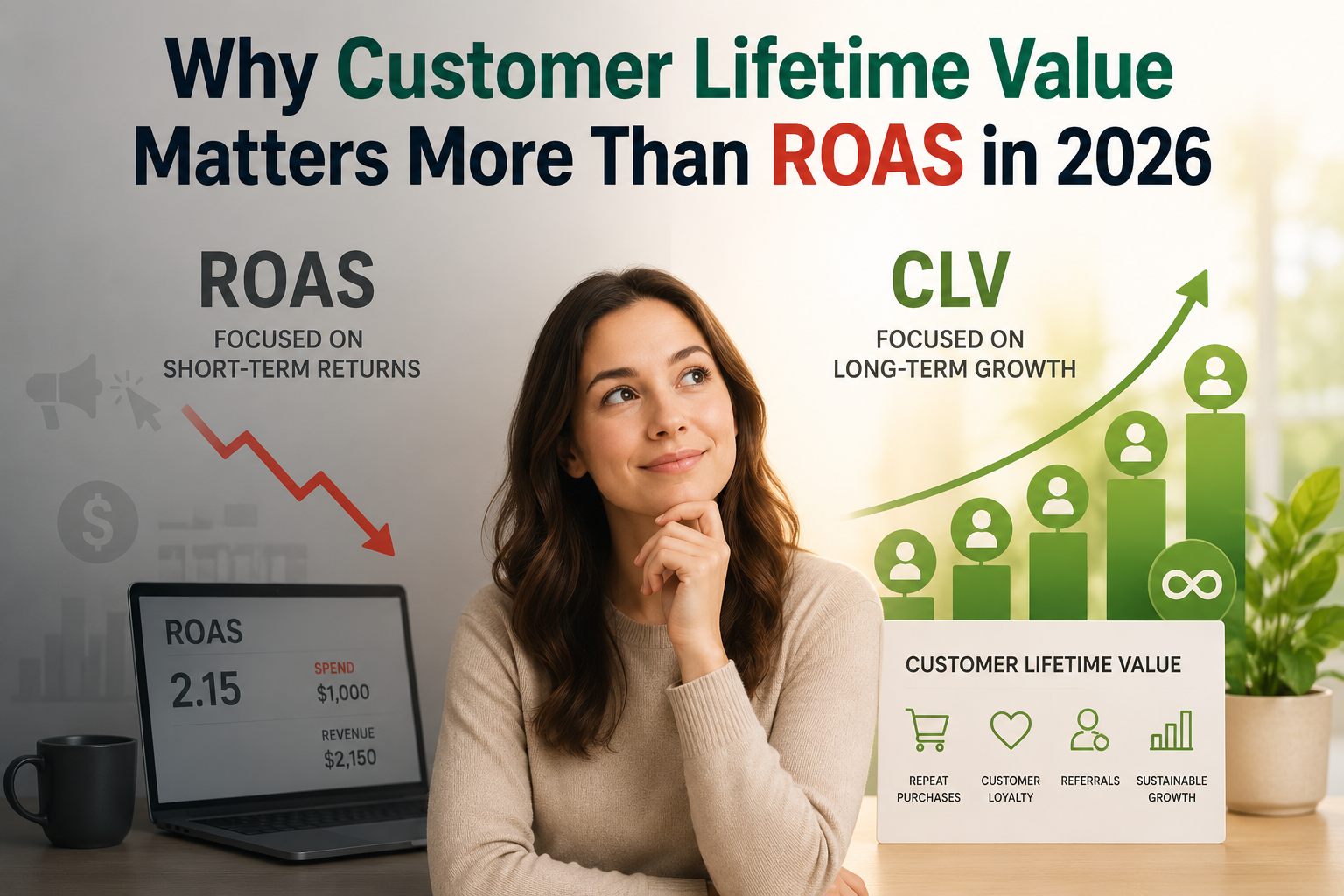
In the early days of eCommerce, most founders obsessed over one metric: ROAS return on ad spend.
If ads generated ₹5 for every ₹1 spent, the campaign was a success. Marketing dashboards celebrated high ROAS numbers, and businesses scaled ad budgets aggressively without looking deeper.
But in 2026, the smartest eCommerce brands are shifting focus to a completely different metric: Customer lifetime value (CLV).
The reason is simple.
ROAS measures a moment. Customer lifetime value measures a relationship.
And in today's highly competitive digital commerce landscape, long-term relationships with customers are far more profitable than short-term ad wins. Let's explore why CLV is becoming the real growth metric and what you can do about it.
Is your store built for long-term customer value?
Most eCommerce stores are optimised for first purchases only. Our team will assess your customer retention gaps and show you exactly where CLV improvements will have the biggest revenue impact free of charge.
Get your free CLV assessment →The problem with ROAS-first thinking
ROAS is useful. But it can also be deeply misleading and the gap between what it shows and what's really happening is costing businesses significant money.
Consider two real scenarios that play out every day in eCommerce:
Scenario A high ROAS, low value
- Ad spend: ₹10,000
- Revenue generated: ₹50,000
- ROAS: 5×
- Customers never buy again
- Total lifetime revenue: ₹50,000
Scenario B lower ROAS, higher value
- Ad spend: ₹10,000
- First purchase revenue: ₹30,000
- ROAS: 3×
- Customers buy 3 more times over the year
- Total lifetime revenue: ₹1,20,000
The campaign with the lower ROAS created 2.4× more revenue. But if you're only watching ROAS on your dashboard, you'd scale the wrong campaign.
That's why focusing purely on ad performance can hide and actively distort the real business picture.
What is customer lifetime value and how do you calculate it?
Customer lifetime value (CLV or LTV) represents the total revenue a customer is expected to generate throughout their entire relationship with your brand. It's the single most important number for understanding whether your business is actually profitable or just busy.
Average order value: ₹2,500
Purchase frequency: 4 times per year
Customer lifespan: 3 years
Now imagine acquiring that customer for ₹1,000 through a targeted ad campaign. That's a 30× return on your acquisition cost completely invisible if you're only measuring ROAS on the first purchase.
This is the type of business math that builds sustainable, compounding growth rather than a treadmill of ever-increasing ad spend.
Why 2026 is the turning point for CLV-focused brands
Several forces are converging right now to make customer lifetime value not just important but essential for survival.
Rising customer acquisition costs
Advertising costs across Google, Meta, and other platforms have increased 40–60% over the past five years. Many eCommerce categories now have cost-per-acquisition figures that make a single purchase barely profitable or outright loss-making. When acquisition becomes this expensive, retention stops being a nice-to-have and becomes the business model.
Privacy changes and tracking restrictions
Changes in iOS privacy settings, cookie deprecation, and evolving data regulations have significantly reduced the accuracy of advertising attribution. ROAS numbers are increasingly unreliable as platforms can no longer track the full conversion journey. Brands that depend entirely on performance marketing data are now navigating partially blind.
The solution is building direct relationships with customers through email, loyalty programmes, and personalised email marketing that don't depend on third-party tracking to function.
Saturated eCommerce markets
In most product categories, customers today have dozens of alternatives at similar price points. Products are comparable. Delivery speeds are comparable. What truly differentiates brands now is customer experience and relationship depth. A customer who has bought from you twice and had a great experience is dramatically less likely to switch than a first-time buyer.
How high-CLV brands think differently
Brands that build their strategy around customer lifetime value make fundamentally different decisions than those chasing ROAS.
Instead of asking: "Did this campaign generate high ROAS?"
They ask: "How many long-term customers did this campaign create?"
That subtle shift changes everything from which campaigns they scale, to how they design post-purchase experiences, to how they measure success.
They prioritise building systems around:
- Better onboarding and post-purchase engagement
- Loyalty and rewards programmes that create habit
- Personalised product recommendations based on purchase history
- Subscription models that create predictable recurring revenue
- Community building that creates emotional connection to the brand
Real example: an apparel brand doubling CLV in 12 months
A growing online apparel store was running profitable ads good ROAS, steady traffic, reasonable revenue. But when they looked at repeat purchase rates, the picture was less comfortable: most customers were buying once and never returning.
They implemented a retention-focused strategy built around four core changes: personalised product recommendations, a loyalty rewards programme, restock alerts for previously purchased items, and email re-engagement campaigns triggered by purchase history.
| Metric | Before | After 12 months |
|---|---|---|
| Average order value | ₹2,000 | ₹2,000 (unchanged) |
| Average purchases per customer per year | 1.6 | 3.8 |
| Customer lifetime value | ₹3,200 | ₹7,600 |
| Revenue growth | Flat | +137% from same customer base |
No new products. No increase in ad spend. Same store, same prices. The only thing that changed was how the business managed its relationship with customers it had already acquired.
What drove the CLV improvement
- Personalised email sequences based on purchase history reduced time between orders
- Loyalty points programme gave customers a reason to return specifically to Satyanam's client instead of searching broadly
- Restock alerts brought back customers for products they'd already validated they liked
- Post-purchase trust-building reduced anxiety and increased confidence in repeat orders
Younifi Wellness building long-term customer value through better eCommerce experience
Younifi Wellness, a health and wellness manufacturer, came to Satyanam struggling with poor user experience and low online sales a business with a strong product but a digital storefront that wasn't doing it justice. Customers weren't returning because the experience wasn't earning their trust. Satyanam rebuilt their eCommerce platform with custom development, seamless API integrations, and thorough QA processes. The improved experience created the foundation for stronger customer relationships and measurable, sustainable revenue growth exactly the kind of CLV-driven outcome that outperforms any single ad campaign.
Read the full case study →Want systems like these built for your store?
Satyanam builds custom loyalty programmes, personalised recommendation engines, and automated re-engagement workflows for Shopify and nopCommerce stores. Let's talk about what's possible for your business.
Book a free strategy call →Five proven strategies to increase customer lifetime value
Improve the post-purchase experience
The customer journey doesn't end at checkout it starts there. Send order tracking updates, product usage tips, follow-up emails, and proactive support messages. A positive post-purchase experience is the single most powerful driver of a second purchase, because it resolves the anxiety that first-time buyers always feel. Our email marketing team builds automated post-purchase sequences that work 24/7.
Use smart personalisation
Customers respond strongly to experiences that feel relevant to them specifically. Show recommended products based on purchase history, send tailored promotions for categories they've already bought in, and personalise email subject lines and product imagery. Personalisation increases repeat purchases because it reduces the mental effort of deciding what to buy next. Our user behaviour analytics service helps identify exactly which personalisation signals matter most for your specific customers.
Launch a loyalty and rewards programme
Loyalty programmes work because of a well-documented psychological principle: people hate losing progress they've built. Once a customer has accumulated points or is close to a reward tier, they return specifically to protect that progress not because they actively need the product right now. Effective programmes offer points per purchase, referral rewards, birthday discounts, VIP tier access, and early product launch privileges.
Introduce subscription models
Subscriptions are the most powerful CLV tool available because they convert an uncertain repeat purchase into a guaranteed one. Industries that benefit most include fashion basics (socks, underwear, essentials), beauty products, health supplements, and any consumable product with a predictable replenishment cycle. Even a small subscription base creates revenue predictability that transforms business planning and cash flow.
Build a community around your brand
Customers who feel emotionally connected to a brand don't comparison shop. They return because the brand is part of their identity or daily life. Community can be built through social media engagement, user-generated content campaigns, customer stories, exclusive member groups, and behind-the-scenes brand content. This is the highest-CLV strategy but also the slowest. It compounds dramatically over 12–24 months.
The real growth equation for eCommerce in 2026
The future of eCommerce growth is not simply about getting more customers. It's about maximising the value of each customer relationship you've already built and paid to acquire.
The brands that will compound their revenue over the next three years are following this equation:
Businesses that understand this equation will consistently outperform competitors who chase short-term ROAS numbers because they're building something that compounds, while their competitors are running a treadmill.
Also read: How to use behavioral analytics to improve checkout conversions →
ROAS will always be a useful metric. But it's only one piece of the puzzle and in 2026, it's becoming a smaller piece every year.
Customer lifetime value tells the bigger story. The story of loyalty, trust, and the kind of long-term revenue that makes a business genuinely stable not just technically profitable on a campaign-by-campaign basis.
The most valuable customer is not the one who buys once because your ROAS looked good that week.
It's the one who comes back in six months, buys again, tells a friend, and eventually becomes a quiet, consistent contributor to your revenue month after month, year after year.
Building that kind of customer base requires investment in experience, technology, and retention systems. But the return on that investment doesn't expire when you stop paying for it.
That's the difference between a business that grows fast and one that grows permanently.
Ready to build systems that increase customer lifetime value?
At Satyanam , we help eCommerce businesses on Shopify, nopCommerce, and WooCommerce build custom loyalty systems, personalised recommendation engines, subscription workflows, automated engagement tools, and advanced analytics dashboards all designed to turn one-time buyers into long-term customers.
Talk to our eCommerce experts →Frequently asked questions about customer lifetime value