
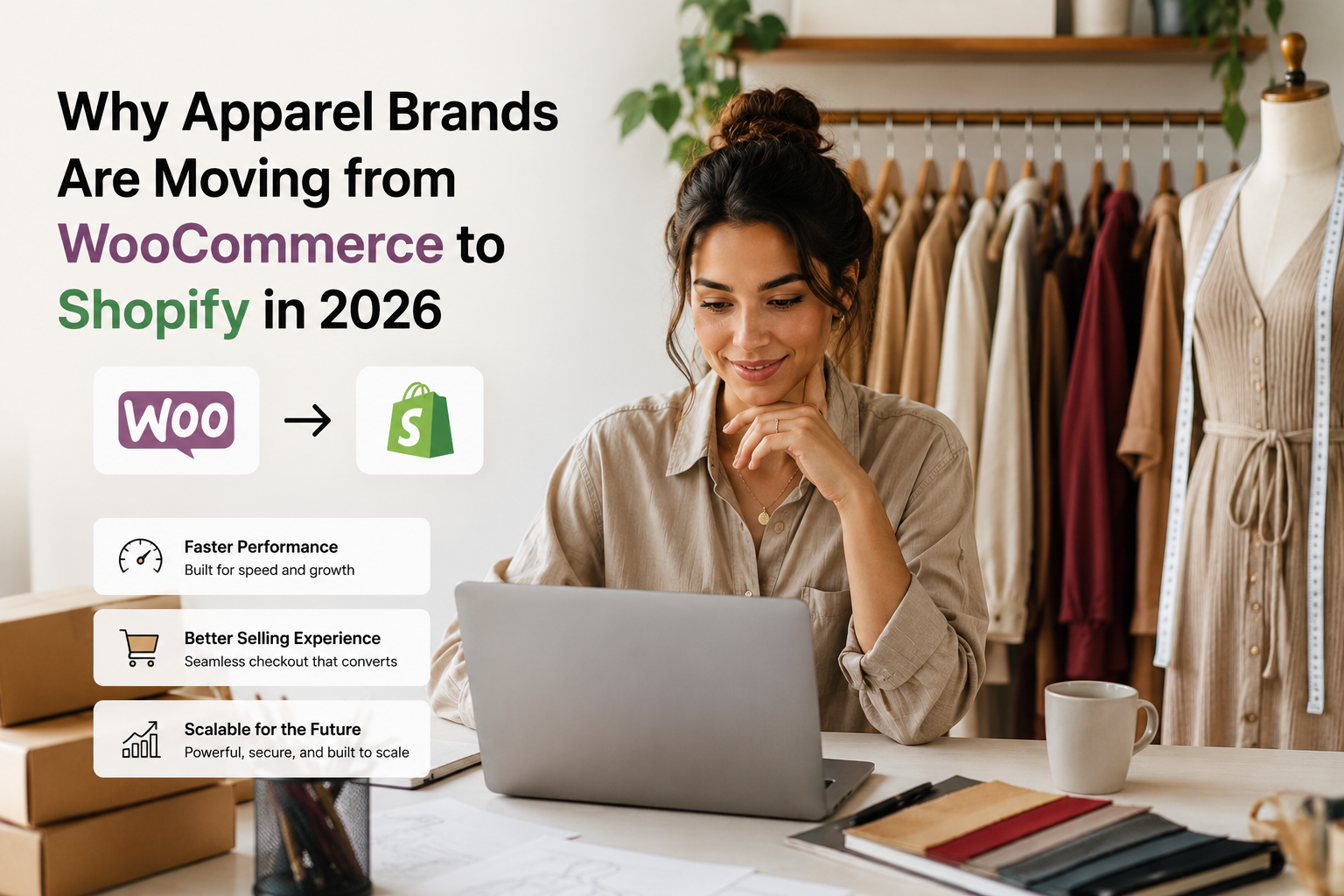
Something quiet is happening across India's fashion and apparel industry right now.
Brands that spent three, four, five years building their stores on WooCommerce investing in plugins, developers, custom themes, and integrations are migrating to Shopify. Not in small numbers. In a wave.
And the interesting part? Most of them aren't doing it because Shopify is "better" in some abstract technical sense. They're doing it because WooCommerce, which was perfectly fine when they had 200 orders a month and one developer, started quietly breaking down as they grew. The cracks appeared slowly at first. Then all at once.
If you're running an apparel brand on WooCommerce and wondering whether this conversation applies to you it probably does. And if you're about to build your first serious eCommerce store and trying to choose a platform, this is the most honest comparison you'll read in 2026.
"WooCommerce was free to start and everything to maintain. Somewhere between ₹2 crore and ₹5 crore in revenue, it stopped being the cheaper option."
Thinking about migrating from WooCommerce to Shopify?
Before you decide, talk to our team. We've managed dozens of apparel platform migrations and can tell you honestly whether Shopify is the right move for your specific business and what it will actually cost and take to do it correctly.
Get a free migration assessment →The WooCommerce promise and where it starts to break
WooCommerce started with an irresistible proposition. Free software. Open-source flexibility. Built on WordPress, the platform powering a third of the internet. You could install it in an afternoon, find a theme for ₹3,000, and be selling by the weekend.
For apparel brands at the start 50 products, a few hundred orders a month, one person managing everything this was genuinely good. The flexibility was real. The community was large. And the total upfront cost was almost nothing.
But WooCommerce's flexibility is also its fragility. The same open architecture that lets you customise everything requires you to maintain everything. Every plugin has its own update cycle. Every update can break something else. Your hosting needs to scale with your traffic. Your security is your responsibility. Your developer is the single point of failure for your entire store.
At small scale, these are manageable inconveniences. At ₹50 lakh annual revenue, they start becoming operational risks. At ₹2 crore, they become a genuine business problem.
Why apparel specifically what makes fashion different from other eCommerce
Not every WooCommerce brand should migrate to Shopify. But apparel brands have specific characteristics that make the pain of WooCommerce especially acute and the benefits of Shopify especially tangible.
Fashion eCommerce has unique demands that other categories don't face with the same intensity:
- High SKU complexity: a single product might have 15 size-colour combinations, each needing its own inventory tracking
- Visual-first shopping: customers make decisions based on how things look, which means image performance directly affects conversion
- Mobile-dominant traffic: fashion shoppers browse on Instagram and buy on mobile more than almost any other category
- Seasonal spikes: Diwali, end-of-season sales, and new collection launches create massive traffic spikes that need infrastructure capable of handling them without crashing
- Return rates: fashion has one of the highest return rates in eCommerce, which means the post-purchase experience and return management need to work seamlessly
WooCommerce handles these requirements adequately when everything is working perfectly. The problem is that "everything working perfectly" requires constant, active maintenance and the moment you stop paying that attention, something breaks at the worst possible moment.
Six real reasons apparel brands are making the move
Mobile performance has become non-negotiable
Over 70% of fashion eCommerce traffic is mobile. Your customers are browsing your new collection on their phone while commuting, while waiting, while lying in bed at 11pm. They have zero patience for slow pages.
WooCommerce stores especially ones that have accumulated plugins, custom code, and heavy theme assets over several years routinely load in 4–6 seconds on mobile. Every second above 2 seconds is costing you conversions. Every second above 3 seconds, a significant portion of your potential customers have already left.
Shopify's infrastructure is built for speed. Their CDN, their image handling, their default checkout flow all of it is optimised for mobile performance at a level that WooCommerce simply cannot match without substantial custom development investment. The same store, migrated correctly, typically loads 2–3 seconds faster on mobile after moving to Shopify.
Checkout abandonment on WooCommerce is a hidden revenue leak
Fashion eCommerce has some of the highest checkout abandonment rates of any category. Part of that is browsing behaviour customers genuinely undecided. But a significant portion is checkout friction.
WooCommerce checkout, even when optimised, requires configuration, plugin maintenance, and constant testing to keep performing well. Payment methods need individual plugin installation and maintenance. Mobile checkout UX depends heavily on your theme. Guest checkout requires specific configuration. Any plugin update can introduce a bug that breaks the flow.
Shopify's checkout is a product in itself. It has been A/B tested billions of times across every industry and device type. It handles UPI, cards, wallets, and BNPL natively. It's optimised for one-thumb mobile use. And it doesn't break because a plugin updated.
Peak season anxiety WooCommerce infrastructure under pressure
Every apparel founder knows the feeling. It's the day of your biggest sale of the year Diwali, end-of-season, a major influencer post just went viral. Traffic is spiking. And then your site goes down.
WooCommerce runs on hosting you manage. Under normal traffic, your shared or VPS hosting is fine. Under peak load, it buckles unless you've invested in infrastructure scaling, which most apparel brands haven't because it's expensive and technical.
Shopify's infrastructure automatically scales with your traffic. There is no "hosting" to manage. No server to upgrade. No calls to a hosting support team at 2am during a sale. The platform handles it because Shopify's business depends on your store staying up as much as yours does.
Developer dependency the single point of failure nobody talks about
WooCommerce brands at growth stage almost always have one developer who knows the store intimately. That developer built the custom theme. They know which plugins conflict with each other. They remember why that specific code was added two years ago.
When that developer leaves, changes rates, or becomes unavailable during a critical moment, the brand is exposed in a way that Shopify brands rarely are. The operational knowledge is locked inside one person's head rather than documented inside a platform.
Shopify's standardised architecture means any competent Shopify developer can pick up your store and understand it quickly. The Shopify ecosystem is large, well-documented, and competitive. You're not dependent on one relationship for the operational health of your entire business.
The real-time inventory management problem for apparel
Apparel inventory is genuinely complex. A single product with 8 sizes and 5 colours is 40 SKUs. Managing those across your own store, an Instagram shop, an Amazon listing, and a physical POS simultaneously without overselling requires real-time synchronisation that WooCommerce handles inconsistently without significant custom development.
Shopify's native inventory management and its integrations with multi-channel inventory tools are significantly more reliable for apparel brands selling across multiple channels. The risk of selling size M Navy Blue twice because two channels didn't sync is dramatically lower.
The true cost of "free" what WooCommerce actually costs at scale
The "WooCommerce is free" argument doesn't survive contact with a realistic cost model for a ₹1–5 crore apparel business. When you add up hosting (₹8,000–₹25,000/month for reliable managed WordPress), premium plugins (₹15,000–₹40,000/year), developer retainer (₹10,000–₹30,000/month), security tools, backup systems, and the time your team spends managing technical issues WooCommerce is often significantly more expensive than Shopify's monthly fee.
More importantly, WooCommerce's cost in developer time is also opportunity cost. Every hour your developer spends updating plugins, fixing WooCommerce conflicts, or troubleshooting hosting issues is an hour not spent on features, integrations, or optimisations that directly grow your revenue.
The honest Shopify vs WooCommerce vs nopCommerce comparison for 2026
If you're making a platform decision or reconsidering your current one here is the most honest comparison available for apparel brands specifically.
| Criteria | Shopify | WooCommerce | nopCommerce |
|---|---|---|---|
| Mobile performance (out of box) | Excellent | Requires significant work | Good with custom build |
| Checkout conversion | Industry-leading native checkout | Requires configuration and plugins | Excellent when custom-built |
| Operational overhead | Very low platform managed | High developer dependent | Medium requires dev team |
| Scalability (traffic spikes) | Automatic no infrastructure management | Requires hosting upgrades | Excellent on right infrastructure |
| Custom workflows (ERP, B2B, complex pricing) | Limited without expensive apps | Possible but fragile | Best-in-class for complex custom logic |
| True monthly cost (₹1–5 crore brand) | ₹8,000–₹20,000/month predictable | ₹25,000–₹60,000/month real total | Higher upfront, lower ongoing |
| Multi-channel inventory sync | Strong native + app ecosystem | Plugin-dependent, unreliable | Excellent with custom integration |
| Best for | Growing apparel brands, D2C, multi-channel | Small stores, content-heavy sites | Enterprise, B2B, complex custom workflows |
What a WooCommerce to Shopify migration actually involves
One of the most common fears apparel founders have about migrating is losing data product listings, customer records, order history, SEO rankings. These are legitimate concerns. A poorly executed migration can cause all of these problems.
A properly executed migration protects everything:
- Product data: all products, variants, images, descriptions, pricing, and inventory levels migrate completely
- Customer records: customer accounts, addresses, and purchase history transfer across
- Order history: historical orders preserved for accounting, customer service, and analytics continuity
- SEO rankings: every existing URL gets a 301 redirect to the equivalent Shopify URL, preserving link equity and Google rankings
- Custom features: functionality specific to your business gets rebuilt in Shopify's ecosystem often more cleanly than it existed on WooCommerce
A typical apparel brand migration takes 4–8 weeks depending on catalogue size and custom functionality complexity. The store runs in parallel until migration is complete there is no downtime window for your customers.
The bottom line and the question worth sitting with
The apparel brands migrating from WooCommerce to Shopify in 2026 are not doing it because WooCommerce is broken. They're doing it because the cost in developer time, operational risk, mobile performance, and the constant anxiety of maintaining infrastructure finally outweighs the flexibility they valued when they started.
Shopify isn't right for every apparel brand. If your business needs deep custom workflows, enterprise-level ERP integration, or full ownership of your codebase, nopCommerce is worth a serious conversation. If you're small and early and the flexibility of open-source genuinely serves you, WooCommerce still has a place.
But if you're a growing apparel brand between ₹50 lakh and ₹10 crore in revenue, spending meaningful money and time maintaining WooCommerce, watching mobile conversion underperform, and losing sleep before every major sale because you're not sure your hosting will hold the question isn't really whether to move. It's when, and how to do it without disrupting what you've built.
The brands making the move now are getting a head start on a more reliable, more performant, more scalable operational foundation. The ones staying on WooCommerce are betting that the maintenance cost is still worth the flexibility. For most apparel brands at growth stage, that bet is increasingly hard to win.
Also read: : How to get more repeat customers on Shopify →
Is it time to move your apparel brand to Shopify?
Satyanam Info Solution manages complete WooCommerce to Shopify migrations for fashion and apparel brands : including product data, customer records, URL redirects, and custom feature rebuilding. We'll tell you honestly whether migration makes sense for your business, what it will cost, and how long it will take. No obligation.
Get a free migration assessment →Frequently asked questions about moving to Shopify
(1) mobile performance WooCommerce sites often load slowly on mobile without significant developer investment,
(2) operational complexity managing WordPress plugins, hosting, and security becomes overwhelming at scale,
(3) checkout conversion Shopify's native checkout consistently outperforms WooCommerce, and
(4) scalability Shopify handles traffic spikes during sales without infrastructure planning.