
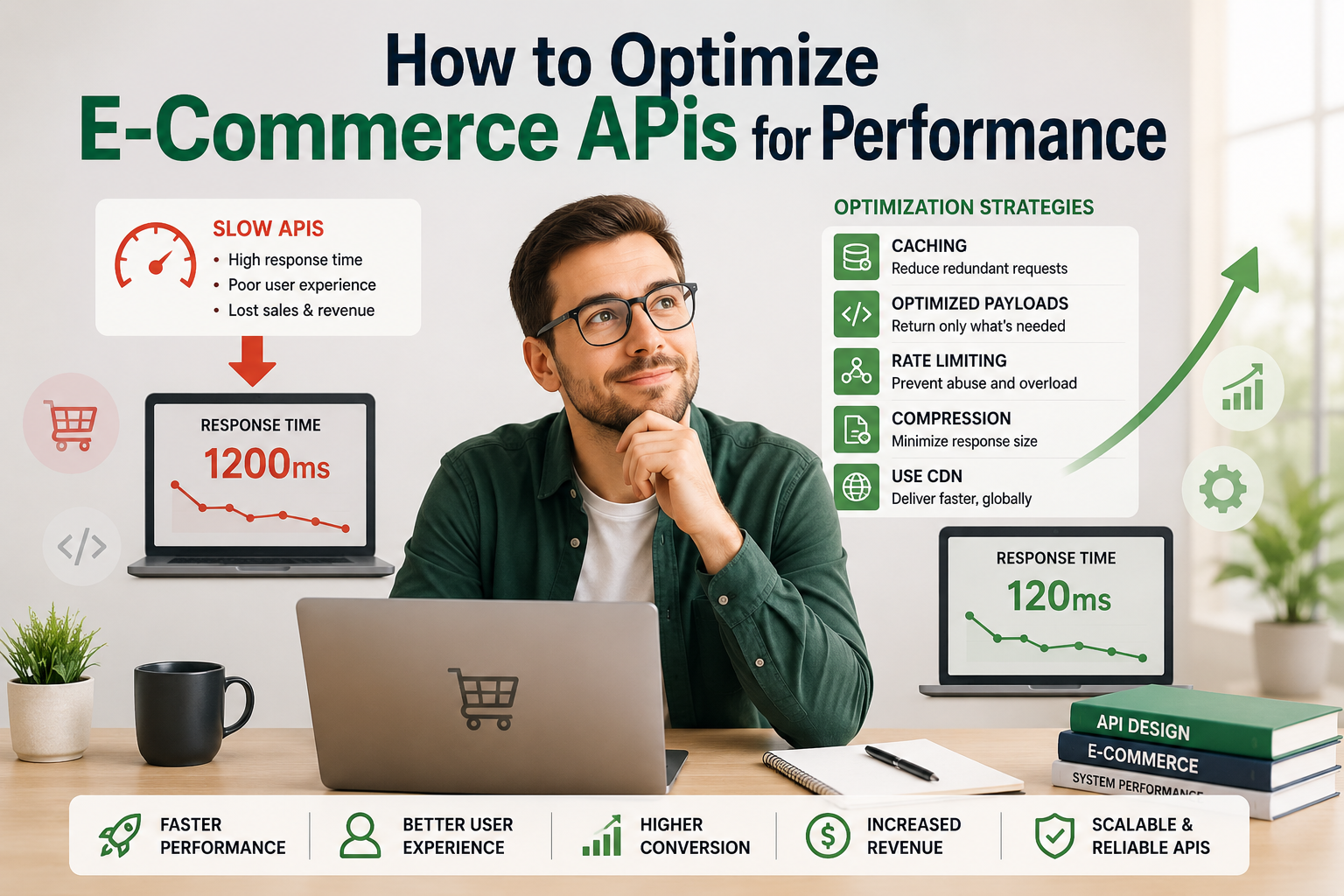
Your eCommerce store loads. Products appear. The customer clicks "Add to Cart."
Nothing happens for 3 seconds.
They leave.
You never find out why. Your Google Analytics shows a bounce. Your ad campaign gets blamed. But the real culprit was invisible a slow API call that made your cart endpoint wait too long before responding.
This happens in eCommerce stores every day, at every scale, on every platform. And it costs real money quietly, consistently, and completely preventably.
API performance is not a developer problem. It is a revenue problem. And in 2025, when customer patience for slow experiences has never been lower, it deserves the same business attention you give to your ad spend and conversion rate.
Is your API slowing down your sales?
Most eCommerce stores don't know their API response times until checkout breaks. Our team will audit your current API architecture and identify performance bottlenecks before they cost you revenue free of charge.
Get your free API performance audit →Why slow APIs destroy eCommerce revenue silently
The dangerous thing about API performance problems is that they rarely announce themselves with an error page. They show up as milliseconds of extra wait time spread across dozens of API calls that compound into seconds of friction that customers feel without understanding.
A typical product listing page on an eCommerce store makes multiple API calls simultaneously: product data, pricing, stock levels, personalised recommendations, cart state, and promotional banners. If each call adds 200ms of unnecessary latency, you've added over a second to your page load before a customer sees a single product.
Unoptimized API what's happening
- Every product page request hits the database directly
- Full product objects returned 80% of fields unused
- Order confirmation triggers sync ERP call customer waits
- No monitoring failures discovered from customer complaints
- Peak sale traffic causes server overload and checkout timeouts
Optimized API what's different
- Product catalogue served from cache zero database hit
- Field filtering returns only what the page actually needs
- ERP updates run async checkout completes in under 1 second
- Real-time monitoring alerts before customers notice issues
- Rate limiting and load balancing protect peak-traffic stability
The store on the right isn't using better hardware or a more expensive hosting plan. It's making smarter decisions about how its APIs work and those decisions compound into a measurably faster, more reliable shopping experience that directly converts better.
Understanding what actually slows eCommerce APIs down
Before optimising anything, it helps to understand where the time actually goes in a slow API response. Most eCommerce API latency comes from one of four places:
Most stores that struggle with API performance are suffering from the first two: slow database queries and synchronous processing of operations that should run in the background. These are also the most impactful to fix and the most achievable without a full infrastructure overhaul.
7 proven techniques to optimize eCommerce API performance
Implement response caching for static and semi-static data
Product catalogues, category trees, pricing data, and promotional banners do not change every second but most eCommerce stores fetch them fresh from the database on every single request. Implement a caching layer (Redis or Memcached) that stores these responses and serves them directly from memory. A 60-second cache on product list data can cut database queries by 80% during peak traffic and reduce response times from 600–800ms to under 30ms. Cache invalidation clearing the cache when products actually change is the only complexity here, and it's well worth managing for the performance gain.
Move to asynchronous processing for background operations
When a customer places an order, your store needs to do many things: send a confirmation email, update the ERP, notify the warehouse, update stock levels, and trigger loyalty point calculations. None of these need to happen before the customer sees their order confirmation. Making them synchronous forces the customer to wait for backend operations that are completely invisible to them. Move every post-order operation to an async queue (RabbitMQ, Azure Service Bus, or AWS SQS). Checkout completes in under a second. Everything else processes in the background. The customer experience is instant. The backend is still accurate.
Reduce payload size with field filtering and compression
A full product object in nopCommerce or Shopify contains dozens of fields: description, variants, metadata, tags, SEO data, related products, and more. A product listing page needs six of them: name, price, image URL, slug, stock status, and rating. Returning the full object wastes transfer time and memory on every request. Implement field filtering so each API consumer requests only the data it needs. Then enable GZIP compression on all API responses. These two changes together typically reduce payload size by 60–80% and cut transfer times proportionally with zero change to your database or hosting setup.
Fix N+1 query problems with eager loading
The N+1 query problem is one of the most common and most damaging performance issues in eCommerce APIs. It happens when your code fetches a list of 20 products, then makes a separate database query for each product to get its images, variants, or categories resulting in 21 database queries instead of 1 or 2. Identify N+1 patterns by monitoring query counts per request. Fix them with eager loading fetch related data in the initial query using joins or includes, not in a separate loop. In most eCommerce stores, eliminating N+1 queries alone cuts API response times by 40–60%.
Add database query optimisation and proper indexing
Unindexed database queries are the single most common cause of slow eCommerce APIs at scale. A query that runs in 10ms with 1,000 products runs in 3 seconds with 100,000 products if the relevant columns aren't indexed. Audit your slowest API endpoints and run EXPLAIN on the queries behind them. Add indexes on columns used in WHERE clauses, ORDER BY, and JOIN conditions especially product category, status, price range, and customer ID. Also review your ORM-generated queries for unnecessary joins and redundant subqueries. These changes have zero effect on small catalogues but dramatic impact on stores that have grown organically over years.
Implement rate limiting and circuit breakers
Peak sales events Diwali, Black Friday, end-of-season sales generate traffic spikes that can overwhelm unprotected APIs and bring down checkout for all customers simultaneously. Rate limiting prevents any single client or integration from consuming disproportionate API resources. Circuit breakers automatically detect when a downstream service (payment provider, ERP, logistics API) is slow or failing, and stop sending requests to it serving a graceful fallback instead of making customers wait for a timeout. Together, these two patterns are what separate eCommerce stores that survive peak traffic from those that crash during their most important sales days.
Monitor p95 and p99 response times not just averages
Average API response time is a misleading metric. An API with an average of 150ms might have a p99 of 4 seconds meaning 1% of requests take 4 seconds, which at 10,000 daily API calls means 100 customers per day experiencing a 4-second wait. Monitor percentile response times (p95, p99) for every critical endpoint: product listing, cart, checkout, and payment. Set alerts that fire before customers are impacted. Use Application Insights, Datadog, or a similar monitoring stack. The goal is to find and fix the slow tail of your response time distribution because that tail is where customer frustration lives.
Real example: how API optimisation transformed a high-speed grocery delivery platform
Needly, a grocery and food delivery platform built for high-speed order processing, came to Satyanam with a critical API performance challenge. Their business model depended on speed customers expected to order groceries and receive them in minutes. But their API layer wasn't built for that kind of throughput. Under real delivery volumes, response times were inconsistent, ERP sync operations were blocking order confirmations, and the mobile app was experiencing timeouts that directly caused order failures.
Satyanam rebuilt their API architecture with a focus on performance from the ground up async processing for all post-order operations, response caching for product and inventory data, payload optimisation across all mobile API endpoints, and a CI/CD pipeline that allowed rapid deployment of improvements without service downtime.
| Metric | Before Optimisation | After Optimisation |
|---|---|---|
| Product listing API response time | 680ms average | Under 45ms with cache |
| Order confirmation time | 3.2 seconds (sync ERP) | Under 800ms (async queue) |
| Mobile app timeout rate | Frequent during peak hours | Eliminated completely |
| Database query count per order | 47 queries per request | 8 queries (N+1 fixed) |
| Peak traffic stability | Degraded performance under load | Consistent under 5× normal traffic |
The result was a platform that could genuinely deliver on its promise of speed not just in the physical delivery, but in every interaction a customer had with the app from browse to order confirmation.
What drove Needly's API performance improvements
- Async processing removed ERP sync from the critical checkout path customers stopped waiting for backend operations
- Redis caching on product and inventory data eliminated 80% of database queries during peak ordering windows
- N+1 query fix reduced database calls per order from 47 to 8 the single highest-impact change
- Payload optimisation on mobile endpoints reduced data transfer by 65% critical for users on slower mobile connections
- Real-time monitoring via CI/CD pipeline allowed the team to catch and fix issues before they became customer-facing problems
Needly: Transforming Grocery Shopping with a High-Speed Delivery Platform
Needly came to Satyanam with a business that was promising customers speed but delivering frustration. Their grocery delivery platform built for high-frequency, time-sensitive orders was being let down by an API layer that couldn't sustain real delivery volumes. Order failures, mobile timeouts, and slow confirmation times were undermining customer trust in a business where trust is everything. Satyanam delivered a completely rebuilt API architecture: async order processing, Redis caching for product and inventory data, optimised mobile API payloads, full ERP integration, and a CI/CD pipeline for continuous improvement. The result was a platform that could genuinely match the speed its customers expected from browsing to order confirmation to delivery tracking, every step fast and reliable.
Read the full Needly case study →Want API performance like this for your store?
Satyanam builds and optimises API architecture for nopCommerce, Shopify, and custom eCommerce platforms caching, async processing, query optimisation, monitoring, and everything in between. Let's look at your store specifically.
Book a free API strategy call →A practical monitoring setup for eCommerce API health
Optimising your APIs once is not enough. Performance degrades over time as your catalogue grows, your integrations multiply, and your traffic increases. You need a monitoring setup that catches regression before customers do.
Track p95 and p99 not averages
Set up response time dashboards that show p95 and p99 percentiles for every critical endpoint. Averages hide the slow tail where customer frustration lives. An API with a 100ms average but a 3-second p99 is failing 1% of your customers on every request which at scale is a significant number every day.
Alert on error rate spikes before customers complain
Set alerts that fire when error rates on checkout, cart, or payment endpoints exceed 0.5% not when they hit 5%. A 0.5% error rate on a store doing 2,000 checkout attempts per day means 10 failed checkouts. Each one is a lost order and a frustrated customer who may not come back.
Load test before every peak sales event
Run load tests simulating 3–5× your normal peak traffic before every major sale. Most API performance problems are invisible at normal traffic levels and only emerge under load. Finding them in a test environment costs nothing. Finding them during your Diwali sale costs orders, customers, and brand trust that is very hard to recover.
Also read: How to build a custom nopCommerce API gateway →
The bottom line
Every millisecond your APIs waste is a millisecond your customer spends waiting. And waiting customers in 2025, with more alternatives than ever available in the same browser tab don't wait long.
API performance optimization is not a one-time project. It is an ongoing discipline the same way you optimize your ad campaigns, your product listings, and your customer experience. The stores that treat it that way build compounding performance advantages over competitors who only notice the problem when checkout breaks.
Start with caching and async processing. Measure the impact. Then work through the rest of this list systematically. Each improvement compounds on the last and together they build the kind of stable, fast, reliable API layer that lets your business scale without fear.
Because the best sale you ever run is the one where checkout works perfectly for every customer, at 10× normal traffic, without a single emergency.
Ready to make your eCommerce APIs genuinely fast?
At Satyanam, we audit, optimise, and rebuild API architecture for nopCommerce, Shopify, and custom eCommerce platforms caching layers, async queues, query optimisation, payload reduction, monitoring stacks, and load testing. Everything your API needs to perform under pressure.
Talk to our eCommerce API experts →Frequently asked questions about eCommerce API performance