
Every eCommerce business owner has experienced it. A customer spends time browsing products. Adds items to the cart. Starts the checkout process.
And then… disappears. No purchase. No explanation. No revenue.
For many online stores, the checkout page is where the biggest revenue leak happens. Studies consistently show that the average cart abandonment rate across eCommerce sits around 70%. That number frustrates business owners because the hardest part getting shoppers interested is already done.
So why are customers leaving at the final step?
Most store owners assume immediately: prices are too high, shipping scared them, they changed their mind. Sometimes that's true. But often, the real answer lies deeper inside customer behavior and that's exactly where behavioral analytics becomes powerful.
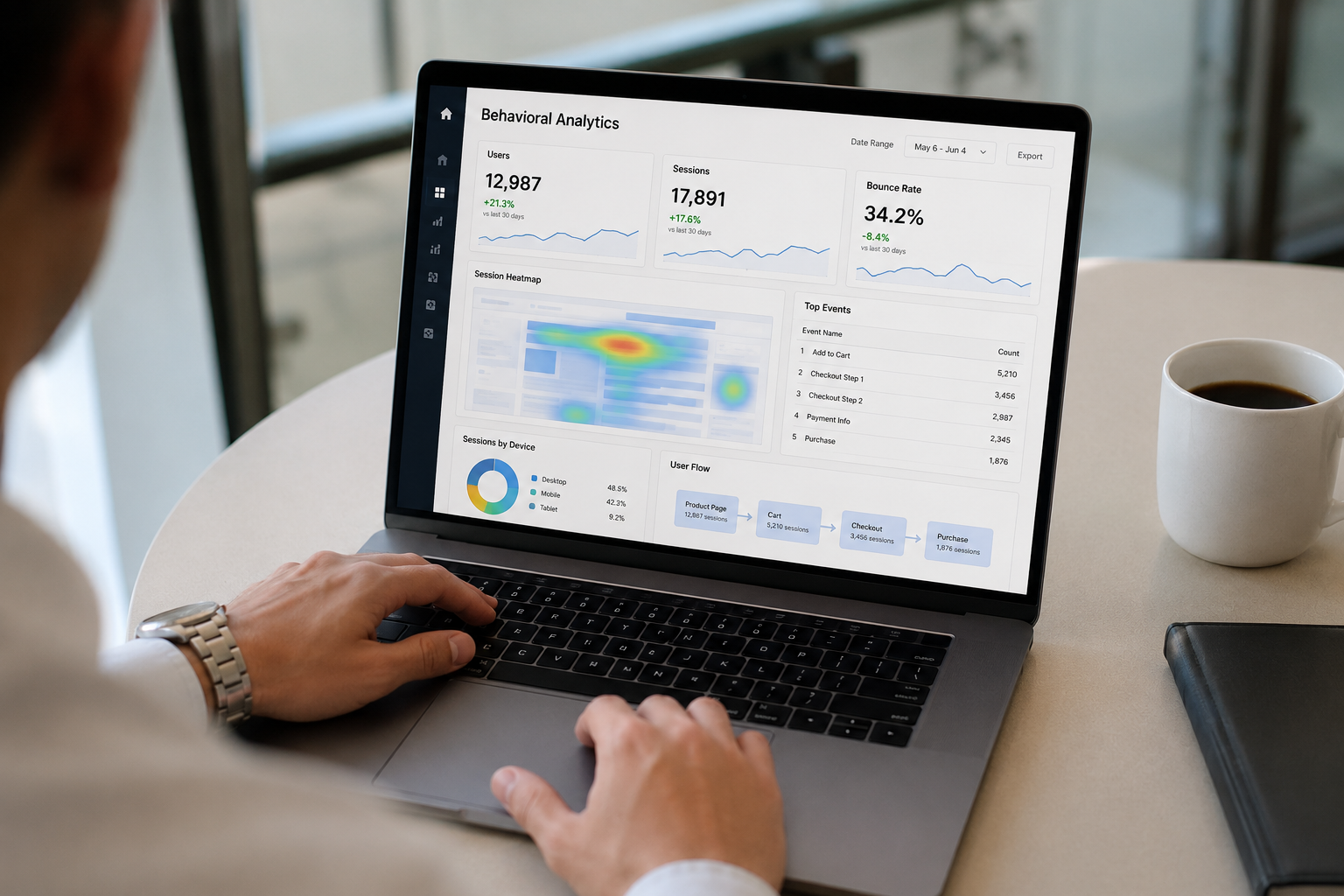
Instead of guessing, behavioral analytics helps you actually see where users hesitate, what frustrates them, which steps create confusion, and where trust breaks down. Once you understand those behaviors, improving conversions becomes far more predictable.
Free checkout conversion audit
Is checkout friction silently killing your revenue? Our team will analyse your checkout flow using behavioral data and identify exactly where you're losing customers for free.
Get Your Free Audit →What is behavioral analytics in eCommerce?
Behavioral analytics is the process of tracking and analyzing how users interact with your online store. Instead of only looking at surface-level numbers like traffic or sales, it focuses on the actual experience customers are having in real time:
- Clicks and tap patterns
- Scroll depth and reading behavior
- Mouse movement heatmaps
- Full session recordings
- Navigation path analysis
- Rage clicks (repeated frustrated tapping)
- Form field abandonment
- Exit behavior and timing
It helps answer one critical question: "What are customers actually experiencing during checkout?" Because data alone doesn't always reveal emotions. Behavior reveals friction.
Why checkout optimization matters so much
For most eCommerce stores, checkout is the closest point to revenue generation. A small improvement here creates a massive financial impact. Consider this example:
- 50,000 monthly visitors
- 5,000 checkout initiations
- 2,500 completed purchases → 2,500 abandoned
Improving checkout conversion by just 10% could result in hundreds of additional orders every month without spending more on advertising. This is exactly why smart eCommerce businesses invest in Conversion Rate Optimisation (CRO) rather than just increasing traffic.
The Psychology Behind Checkout Abandonment
Most checkout abandonment is emotional before it's technical. Customers leave because something creates uncertainty. It could be unexpected shipping fees, slow page loading, too many form fields, lack of trust badges, confusing coupon systems, forced account creation, payment failures, or mobile usability issues.
The challenge is that users rarely explain why they leave. Behavioral analytics uncovers those silent frustrations turning invisible problems into fixable ones.
Key behavioral analytics tools eCommerce stores use
Heatmaps
Show where users click, move, and focus attention. Quickly identify ignored buttons, distracting elements, and confusing layouts. If shoppers click non-clickable elements repeatedly, it signals design confusion.
Session recordings
Replay actual customer journeys. Observe hesitation before payment, repeated form corrections, rage clicks, and navigation loops problems traditional analytics completely miss.
Funnel analysis
Shows exactly where users drop off during checkout. Identify which specific step is causing the highest abandonment and prioritize fixes accordingly.
Form analytics
Identifies which form fields cause friction which ones users abandon, where they spend too long, and where validation errors repeatedly appear. Long forms are one of the biggest conversion killers.
Checkout funnel: where the revenue leaks
Here is a typical funnel breakdown behavioral analytics might reveal for your store:
| Checkout step | Users | Drop-off |
|---|---|---|
| Cart page | 1,000 | |
| Shipping Info Page | 700 | −30% |
| Payment Page | 500 | −29% |
| Order Confirmation | 450 | −10% |
This tells you exactly which step needs the most attention so you stop guessing and start fixing the right thing first.
5 Common checkout problems behavioral analytics reveals
1. Mobile friction
Many store owners test checkout on desktop but never experience what mobile users face. Behavioral analytics typically reveals buttons too small to tap, difficult keyboard input, broken autofill, and poor one-hand usability. With mobile commerce accounting for over half of all online shopping traffic, these issues directly impact revenue every single day.
2. Unexpected costs
Users frequently abandon checkout the moment they see shipping fees, taxes, or hidden charges that weren't shown earlier. Session recordings clearly show this behavior pattern customers scroll back, pause, and then leave. Transparent pricing shown early in the journey reduces this friction significantly.
3. Forced Account Creation
One of the most common and easily fixable conversion barriers. Customers want convenience. If they're forced to create an account before purchasing, many leave instantly. Behavioral analytics frequently shows abandonment spikes precisely at login or registration pages.
4. Slow Checkout Speed
Even a few seconds of extra loading time can significantly damage conversion rates. Research shows that every additional second of load time reduces conversions measurably. Behavior tracking pinpoints slow-loading payment steps, delayed page transitions, and unresponsive buttons all invisible in standard analytics.
5. Confusing coupon code experience
A visible coupon box can unintentionally reduce conversions. Why? Because customers pause to search for discount codes elsewhere and many never return. Session recordings regularly show users leaving checkout after noticing promo code fields. The fix is often as simple as hiding or collapsing the coupon field.
Real example: Behavioral analytics in action
An online fashion retailer noticed high checkout abandonment despite strong product engagement. Traditional analytics showed good traffic, strong add-to-cart rates but poor checkout completion. Standard reporting offered no clear answer.
Behavioral analysis revealed the actual issue: mobile users struggled with the address form because autofill was broken, the keyboard covered key buttons, and validation errors were unclear.
The business redesigned the mobile checkout flow based directly on what the behavioral data showed.
Results after optimization
- Checkout completion increased by 18%
- Mobile conversion improved by 24%
- Customer support tickets related to checkout dropped significantly
The issue was never pricing. It was friction and behavioral analytics made it visible.
5 Ways to Improve Checkout Conversions Using Behavioral Data
1. Simplify the Checkout Flow
Reduce unnecessary steps. The fewer actions required to complete a purchase, the better the experience feels and the higher your completion rate. Use A/B Testing to validate which simplified flows perform best before rolling out to all users.
2. Improve trust signals near payment
Behavioral analytics often reveals hesitation exactly at the payment step. Add secure checkout badges, trusted payment logos, return guarantees, and clear delivery expectations at this point to reduce anxiety and build confidence.
3. Optimize for mobile first
Design checkout with mobile in mind from the very start not as an afterthought. Our Responsive Web Designing team builds mobile-first checkout experiences that eliminate the friction behavioral data consistently reveals.
4. Enable guest checkout
Removing forced account creation is one of the highest-ROI changes any eCommerce store can make. It consistently improves conversion rates with minimal development effort.
5. Reduce form complexity
Ask only for what's absolutely necessary to complete the purchase. Use form-level funnel analysis to identify which specific fields are causing users to abandon then eliminate or simplify them.
The real goal: Understanding your customers, Not just your numbers
Beyond conversion improvements, behavioral analytics reveals something deeper customer intent. It shows how shoppers think, where trust breaks, what creates hesitation, and what improves confidence. The brands winning in 2026 are not the ones spending the most on ads. They are the ones creating the smoothest buying experiences.
Checkout optimization is no longer about guessing. It's about understanding behavior. And every friction removed creates compounding growth better conversions, happier customers, lower support costs, and stronger word-of-mouth.
Also read: How to Get More Repeat Customers on Shopify →
Want to improve checkout conversions for your eCommerce store?
At Satyanam, we help eCommerce businesses using Shopify and nopCommerce optimize checkout flows through behavioral analytics, UX improvements, A/B testing, and performance optimization. We uncover hidden friction points that are silently costing you revenue.
Talk to Our CRO Experts →Frequently asked questions