
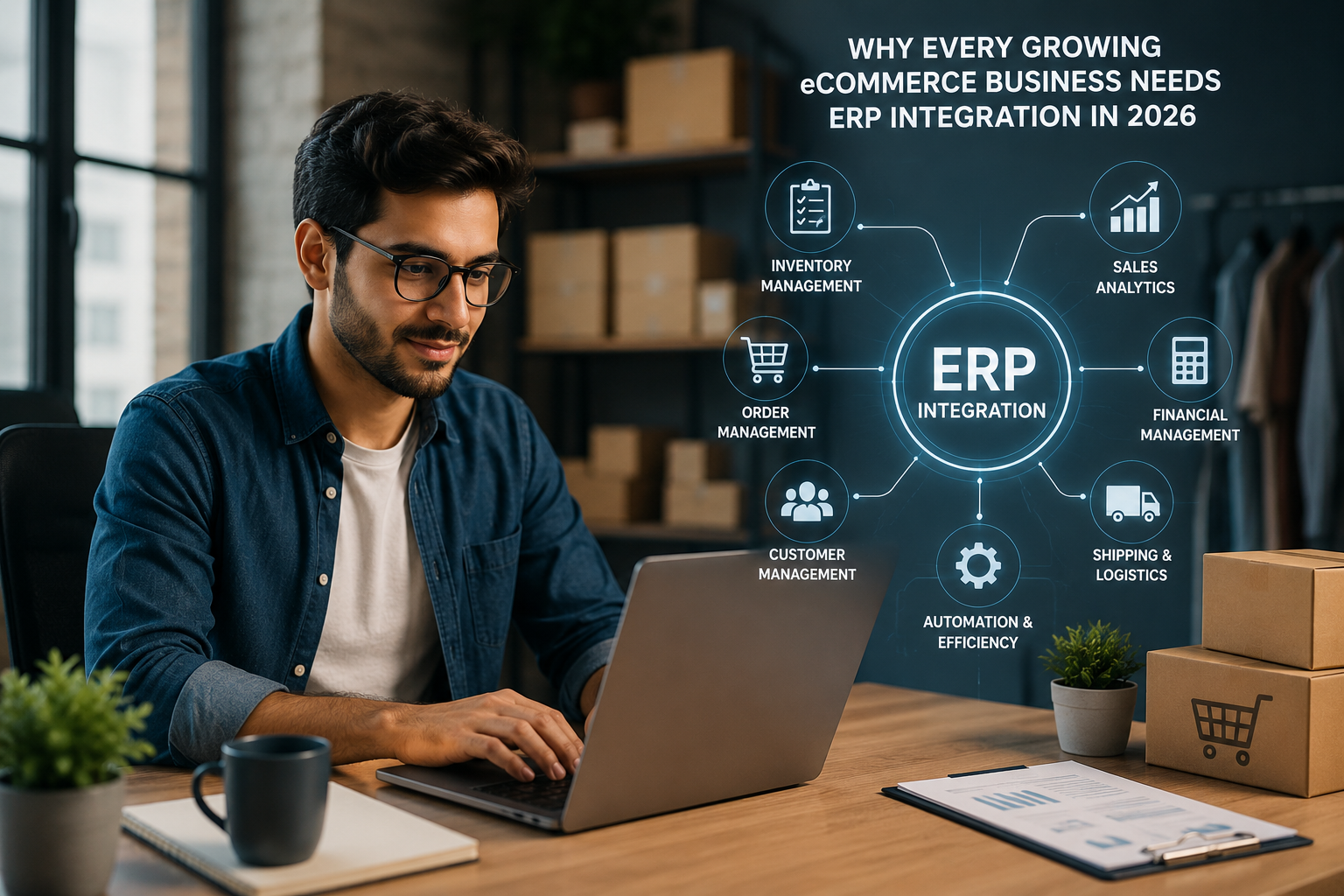
There is a version of growth that feels good on paper but quietly becomes unmanageable.
Orders are up. Revenue is climbing. The team is busier than ever. But behind the numbers, something isn't working as smoothly as it looks. The accounts team is spending three hours every morning re-entering yesterday's orders into Tally. The warehouse is shipping from stock numbers that are always slightly wrong because inventory updates happen twice a week, not in real time. A customer calls asking where their order is, and nobody has a clear answer because the data is split across three different systems that don't talk to each other.
This is the growth trap that catches almost every eCommerce business at some point. The workflows that were perfectly fine at 50 orders a month become the primary bottleneck at 500. And the answer isn't hiring more people to manage the manual processes. The answer is connecting your systems so the processes run themselves.
That connection is ERP integration. And in 2026, for any eCommerce business that is genuinely trying to scale, it has moved from optional infrastructure to a competitive necessity.
How much time is your team spending on manual data entry right now?
If the honest answer is more than a few hours a week, the ROI case for ERP integration is probably already there. Let's look at your specific systems and show you what integration would actually mean for your operation, no obligation, no cost.
Get a free integration assessment →The hidden cost most growing businesses don't calculate
When business owners think about the cost of manual processes, they usually think about the time. And the time is genuinely significant re-entering orders, reconciling accounts, updating spreadsheets, chasing vendors for stock ETAs that then have to be manually entered into the system.
But the more damaging cost is the one that doesn't show up on a timesheet. It's the decisions made on slightly wrong data. The stock level that showed 12 units available when the warehouse actually had 3, leading to an oversell that required a refund and a customer service conversation. The monthly accounts that took four days to close because nobody trusted the automated export and everything had to be cross-checked manually. The sales opportunity that was missed because the CRM didn't have an accurate view of which customers hadn't ordered in 90 days.
These costs are diffuse. They don't appear as a line item. But they compound and they consistently grow faster than the business does, because manual processes don't scale.
"The business grew 3x in two years. The team grew 1x. The gap was filled with overtime, spreadsheets, and a slowly increasing error rate. Integration was the only way out."
How to know if your business has already outgrown manual workflows
The signs are usually visible long before the team acknowledges them. Here are the clearest indicators that ERP integration has shifted from a future project to an urgent present need:
Your team spends Monday mornings on data entry
If weekend orders have to be manually entered into your ERP at the start of every week, that's a structural inefficiency that only gets worse as order volume grows. It also means Monday morning decisions are made on Friday's data.
Your website stock doesn't match your warehouse
If what the website shows as available and what the warehouse actually has are different numbers even slightly you have an oversell waiting to happen. At scale, it will happen regularly. Real-time inventory sync eliminates the gap entirely.
You've had at least one shipping error caused by wrong data
A wrong quantity, a wrong product code, a shipment sent from the wrong warehouse if this has happened because of a data entry error rather than a human mistake, the integration problem has already cost you money and customer trust.
Month-end close takes longer than it should
If your accounts team is spending days reconciling your eCommerce store data against your ERP because the exports don't match cleanly, that's a direct integration problem and the hours are almost certainly larger than the cost of fixing it.
What ERP integration actually does and what it changes
ERP integration connects your eCommerce store directly to your operational systems your accounting platform, your inventory management, your warehouse, your CRM so that data flows automatically between them the moment something happens.
An order placed at 11pm doesn't wait until Monday morning to appear in Tally. It creates an accounting entry the moment it's placed. A shipment received from a supplier at the warehouse doesn't wait for the spreadsheet to be updated. It updates the store's available stock in real time. A customer who just placed their fifth order doesn't need to be manually flagged in the CRM. Their record updates automatically, triggering the loyalty sequence that's already been set up to fire at that point.
Without ERP integration
- Orders re-entered into Tally every morning by a person
- Inventory updated from spreadsheets on a weekly schedule
- CRM records imported monthly always out of date
- Errors discovered after they've caused customer problems
- Month-end close takes days of manual reconciliation
With ERP integration
- Every order creates a Tally entry automatically on placement
- Inventory reflects real warehouse stock at all times
- CRM updates on every customer interaction automatically
- Errors caught by the system before they reach the customer
- Month-end close becomes a review, not a reconciliation
The four integrations that matter most for growing eCommerce brands
Store to accounting ERP Tally, Zoho Books, or SAP
For most Indian eCommerce businesses, the Tally integration is the one that recovers the most hours fastest. Orders flow from your store into Tally automatically with product codes, GST calculations, customer details, and payment status all mapped correctly the moment they're placed. No manual entry. No batch exports. No risk of a transposed number making it into your books. The integration also works in the other direction: supplier invoices posted in Tally can update stock levels in your store automatically, keeping your product availability accurate without anyone having to remember to update it.
Real-time inventory sync across all channels
If you're selling on your own store, a marketplace, and potentially through a physical location simultaneously, real-time inventory sync is not a nice-to-have it's what prevents the same unit from being sold twice. A centralised inventory system that updates all channels the moment any sale happens anywhere eliminates the oversell problem entirely. It also means your team never has to manually synchronise stock counts between platforms, which is one of the highest-volume manual tasks in multi-channel eCommerce operations.
Warehouse management integration pick, pack, ship with accurate data
The warehouse is where inventory errors become customer problems. When the warehouse is working from order data that automatically populates pick lists, confirms dispatch back to the store, and updates inventory on every movement without anyone having to manually communicate that information the entire fulfilment chain becomes faster and more accurate. This integration is particularly important for brands that have grown to the point where the founder or a senior manager can no longer personally oversee every shipment.
CRM integration customer intelligence that stays current
A CRM that's updated monthly via CSV import is a contact list. A CRM that updates in real time on every customer interaction is a business intelligence tool. When your Zoho CRM or HubSpot knows the moment a previously loyal customer stops ordering, the sales team can reach out before they've gone to a competitor. When it knows which customers have just crossed a spend threshold, it can trigger the VIP sequence automatically. None of this is possible without the integration layer that keeps the CRM current.
Lean Products transforming lean manufacturing with integrated eCommerce and ERP
Lean Products, a manufacturing and wholesale business, came to Satyanam with a fundamental problem: their eCommerce platform and their operational systems were completely disconnected. Orders had to be manually transferred into their ERP, inventory was always running slightly behind, and the customer and order management overhead was growing faster than the business. Satyanam built a modernised eCommerce platform with direct ERP integration — connecting order management, large inventory tracking, and production operations into a single system. Customer and order data now flows automatically between the store and the ERP, giving the team a single accurate view of their operation without manual synchronisation work.
Read the full Lean Products case study →Lola Jeans multi-country apparel ERP integration streamlines shop and online transactions
Lola Jeans, a women's apparel manufacturer operating across multiple countries, needed their eCommerce platform and ERP to work as one — handling both retail and wholesale transactions, across different currencies and markets, without creating a data management overhead that would require a dedicated team to maintain. Satyanam built an integrated solution connecting their eCommerce store directly to their ERP, with both shop and online transaction data flowing automatically into a single system. Wholesale order management, inventory tracking, and customer accounts became unified across markets — giving the business the operational clarity it needed to grow internationally without proportionally scaling its back-office headcount.
Read the full Lola Jeans case study →The integration question most businesses get wrong
The most common mistake businesses make when approaching ERP integration is treating it as a technology project rather than an operations project.
They ask "which integration tool should we use?" before they've answered "which data needs to flow in which direction, at what frequency, and what happens when it fails?" The technology is the last decision. The first decisions are operational ones and getting them right is what determines whether an integration genuinely solves the problem or just moves it to a different layer.
Also read: How to integrate nopCommerce with ERP and CRM systems →
Also read: How custom automation can save retailers 20+ hours every week →
ERP integration is not a project for large enterprises. It's the infrastructure decision that growing eCommerce businesses make when they've recognised that manual processes are now the ceiling on their growth, not just an inconvenience.
The businesses that integrate early get a compounding operational advantage. Their data is always accurate. Their team's time is spent on higher-value work. Their errors are caught by the system before they reach customers. Their month-end close is a confirmation, not an investigation.
The ones that wait typically integrate eventually but at a higher cost, because the technical debt and data inconsistencies accumulated during the manual period make the integration more complex than it needed to be.
The best time to connect your systems was when you first noticed the manual processes becoming a problem. The second best time is now.
Ready to connect your eCommerce store to your ERP?
Satyanam Info Solution has built ERP integrations for apparel manufacturers, fashion retailers, grocery platforms, B2B wholesalers, and lean manufacturing businesses across nopCommerce, Shopify, and WooCommerce. Tell us what systems you're running and we'll map out exactly what a proper integration looks like for your operation free, no commitment.
Book your free integration consultation →Frequently asked questions about eCommerce ERP integration


The biggest win isn't just saving time—it's making smarter decisions with accurate data. When your inventory, orders, and accounting are always in sync, your team can focus on growing the business instead of fixing problems. If you're still relying on spreadsheets and manual updates, it might be time for an upgrade.
And after you're done optimizing your workflow, why not take a quick break? Check out https://big-clash.it.com/ for a little entertainment