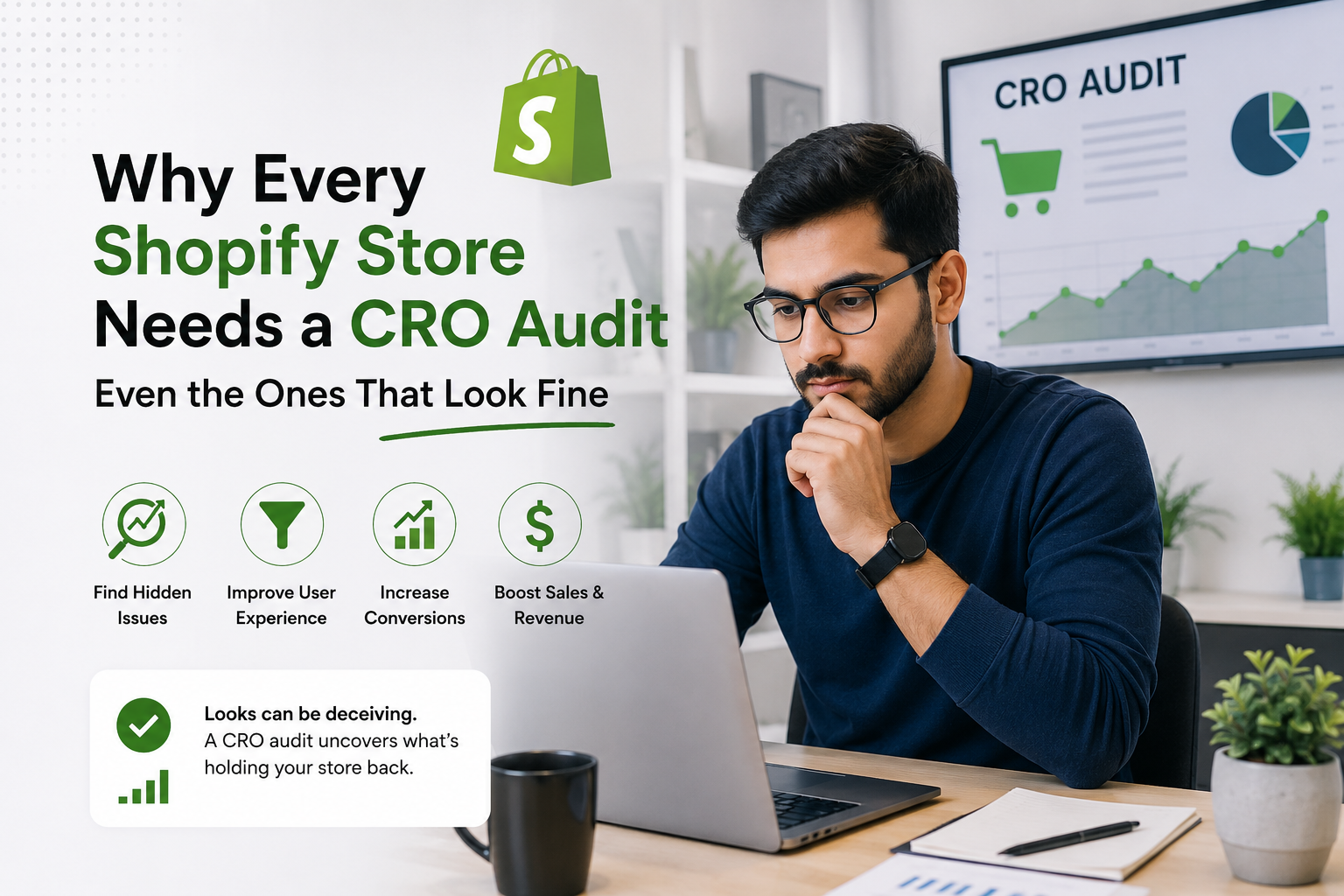
Most store owners only think about a CRO audit when something is clearly broken.
Sales have dropped. Ads stopped converting. The checkout is throwing errors. There is an obvious problem, so they look for an obvious fix.
But the stores with the most expensive revenue leaks are often the ones where nothing feels obviously wrong. Steady traffic. Decent reviews. A conversion rate that has been sitting at 1.4% for eight months. No red flags. No alarms going off. Just a store that is performing well enough that nobody is asking the question that needs to be asked:
What is happening to the other 98.6% of visitors?
They clicked your ads. They found your store. They browsed your products. And then they left, silently, without complaint, without giving you any signal at all and you never found out why.
That silence is the most expensive thing in your business right now. And a CRO audit is how you end it.
Curious what's hiding in your store right now?
We'll look at your funnel data, checkout flow, product pages, and mobile experience and tell you exactly where visitors are leaving and why. No hard sell. Just honest findings.
Get your free Shopify CRO audit →Why "good enough" conversion rates are the most dangerous ones
There is a specific type of Shopify store that a CRO audit is most likely to transform and it is not the store with obvious problems.
It is the store where the owner has made peace with current performance. Where the conversion rate has been stable for long enough that stability feels like success. Where the question "why isn't this converting better?" has never been formally asked because nothing is forcing the conversation.
These stores are sitting on compounding losses that nobody is measuring. If your store converts at 1.5% and a CRO audit finds fixes that bring it to 2.5%, that is not a 1% improvement. It is a 67% increase in orders from the same traffic, every day, every week, every campaign, from this point forward without paying for additional visitors.
What a CRO audit actually looks for and where it usually finds the most
A proper Shopify CRO audit is not a design review. It is not someone saying your homepage looks dated or your product photos could be better. It is a systematic, data-driven investigation of the specific points where your visitors lose momentum and leave and the reasons behind each drop-off.
The methodology has five layers, each one revealing a different type of friction.
Funnel analysis finding your biggest drop-off in Shopify Analytics
The first question in any CRO audit is where in the funnel are visitors leaving in the highest numbers. Open Shopify Analytics → Reports → Online store conversion and look at the percentage drop between each step: sessions to product views, product views to add-to-cart, add-to-cart to checkout, checkout to purchase. The largest percentage drop is your highest-priority fix. In most stores, this data has been sitting in Shopify, unread, for months and it tells you immediately where to focus.
Session recordings watching real visitors use your store
Analytics tells you where visitors leave. Session recordings tell you what they do before leaving. Tools like Microsoft Clarity (free) or Hotjar record real browsing sessions, where people click, how far they scroll, where they pause, and exactly what they were looking at when they closed the tab. Five minutes of watching real session recordings on your product pages almost always reveals something that no amount of analytics data would have shown you. A customer who scrolls to the size guide, reads it, looks confused, and then leaves is giving you a very specific signal about what to fix.
Checkout flow audit on mobile testing what your customers actually experience
Most store owners design and test their Shopify checkout on a laptop. Most of their customers shop on a phone. These are not the same experience and the gap between them is often where the most expensive friction lives. A checkout audit runs the complete purchase flow on multiple real mobile devices on mobile data, timing each step and noting every moment of friction: small tap targets, form fields that trigger the wrong keyboard, shipping costs that appear too late, payment options that require typing a full card number when one-tap alternatives exist. Enabling Shop Pay, Apple Pay, and Google Pay at checkout is often the single change with the highest measurable impact particularly for stores with predominantly mobile traffic.
Product page trust audit what does a first-time visitor actually see?
Open your best-selling product page and look at it as a stranger would. Not as someone who built the store or who already trusts the brand. As someone who arrived from an ad they clicked on a phone while waiting for something, and now has 15 seconds to decide whether to keep looking or move on. Is your returns policy visible without scrolling? Are there real customer reviews with photos, not just stars that confirm the product looks like the photos? Is the size guide inline on the page or buried three taps away? Every hesitation a first-time visitor would feel is a conversion problem and product pages that have been live for a year often accumulate these without anyone noticing.
Page speed audit the problem that affects every visitor before anything else
Page speed affects conversion rate before a single product has been seen. A store that takes 5 seconds to load on mobile loses more than half its visitors before the page is finished rendering and those visitors never even had the chance to become customers. Check your store through Google PageSpeed Insights (pagespeed.web.dev) and look at the mobile score specifically. Then check your Core Web Vitals report in Google Search Console for real-world data from actual visitors. A CRO audit that doesn't include page speed is missing the variable that affects the most people at the earliest possible point.
The difference between a store that's "fine" and one that's actually working
The store that "looks fine"
- Conversion rate: 1.4% - same as last quarter
- Cart abandonment: 74% - untracked, accepted as normal
- No session recordings ever watched
- Last checkout change: when the store launched
- Mobile tested on one iPhone, on Wi-Fi, by the owner
The store after a CRO audit
- Conversion rate: 2.6% - found and fixed the friction
- Cart abandonment: 51% - recovery emails now running
- Session recordings reviewed monthly - issues caught early
- Checkout rebuilt for mobile - Apple Pay, guest checkout
- PageSpeed mobile score: 71 - up from 34
What a real audit found in a store with no obvious problems
A clothing retailer approached Satyanam with a Shopify store they described as working fine. Traffic was healthy. Reviews were positive. There were no broken pages, no error messages, nothing they could point to as a problem. Their conversion rate had been 1.6% for four months and nobody had asked why it wasn't higher.
A full CRO audit using Shopify Analytics, session recordings, and mobile device testing found five specific issues none of which had ever been identified because none of them were obviously broken. They were just quietly costing orders every day.
| What the audit found | Impact on conversion | Fix applied |
|---|---|---|
| Returns policy visible only in footer 3% of visitors ever saw it | High abandonment on product pages from first-time visitors | Added above add-to-cart button on all product pages |
| Checkout required account creation before payment | 34% of mobile users abandoning at this specific step | Guest checkout enabled one less barrier before payment |
| Mobile PageSpeed score: 29 - 6.4 second load time | Over half of mobile visitors leaving before page loaded | Image compression + app audit score to 68, load to 2.1s |
| No cart recovery email sequence | 74% of carts abandoned with zero follow-up | 3-email Klaviyo sequence 12% of carts recovered |
| Ad traffic sent to homepage, not product landing page | Visitors couldn't find the product they'd seen in the ad | Ad destinations matched to specific product pages |
The outcome from a store that "looked fine"
- Conversion rate moved from 1.6% to 2.9% over 10 weeks
- Cart abandonment fell from 74% to 56% after checkout friction was removed
- Klaviyo cart recovery sequence added 12% more completed orders with zero extra ad spend
- Mobile bounce rate dropped once the page actually loaded in under 3 seconds
- Every fix was validated with A/B testing before rolling out site-wide
WooCommerce clothing retailer: repeat purchase rate from 14% to 31% after CRO sprint
A clothing retailer came to Satyanam not because their store was broken, but because their CRO metrics told a quiet story nobody had been reading. Their repeat purchase rate had sat at 14% for over a year not alarmingly low, but not where it should have been for a brand with genuinely satisfied customers. A CRO sprint identified the gaps: no post-purchase Klaviyo flows, no wishlist or size-alert features for out-of-stock items, and a checkout that made returning customers start from scratch every time. After implementation, repeat purchase rate moved from 14% to 31% a 121% improvement. Customer lifetime value increased 58%. And 22% of visitors who had previously left without buying came back through the wishlist size-alert feature.
View all case studies →Want us to check what's hiding in your store?
Satyanam's CRO service includes a full audit of your Shopify store : funnel data, session recordings, checkout flow, mobile experience, and page speed followed by prioritised fixes validated through A/B testing. The audit itself is free.
Book a free strategy call →When should you run a CRO audit and how often?
The honest answer is: right now, and then every six months.
Your store is not static. Products change. Traffic sources shift. Your customer base evolves. A CRO audit done 12 months ago reflects a store and a customer that may not exist in the same form today. The friction points that cost you conversions in 2025 may not be the same ones costing you conversions now.
A store that looks fine is not the same as a store that is working as well as it could.
The most expensive revenue leaks in eCommerce are not the obvious ones. They are the friction points nobody notices, the shipping cost that appears too late, the checkout step that doesn't work smoothly on a mid-range Android, the product page that almost answers the customer's question, the cart that goes silent after abandonment with no follow-up.
None of these show up as a crisis. They just quietly reduce the percentage of visitors who buy, month after month, campaign after campaign while the store looks perfectly fine from the outside.
A CRO audit finds them. And fixing them is almost always the highest-return investment a growing Shopify store can make because unlike ad spend, which stops the moment you stop paying, every conversion improvement you make works for every visitor from that point forward.
Want us to check exactly what's holding your store back?
We will look at your conversion funnel, session recordings, checkout flow, mobile experience, and page speed and give you a plain-English report on what to fix first and why. No obligation. No hard sell. Just an honest look at what your store is actually doing with the traffic you're already paying for.
Get your free Shopify CRO audit →Frequently asked questions