
There is a version of your business running right now that nobody intended to build.
It has four people doing the same data entry in four different places. It has Shopify showing 340 units in stock while the warehouse physically has 280. It has someone pulling orders every morning and typing them into Tally by hand a process that takes two hours, creates three mistakes per week, and is nobody's idea of a good use of their time.
This is not a people problem. Your team is doing exactly what the system asks them to do. The problem is that your systems don't talk to each other and the cost of that silence grows every single month as your order volume increases.
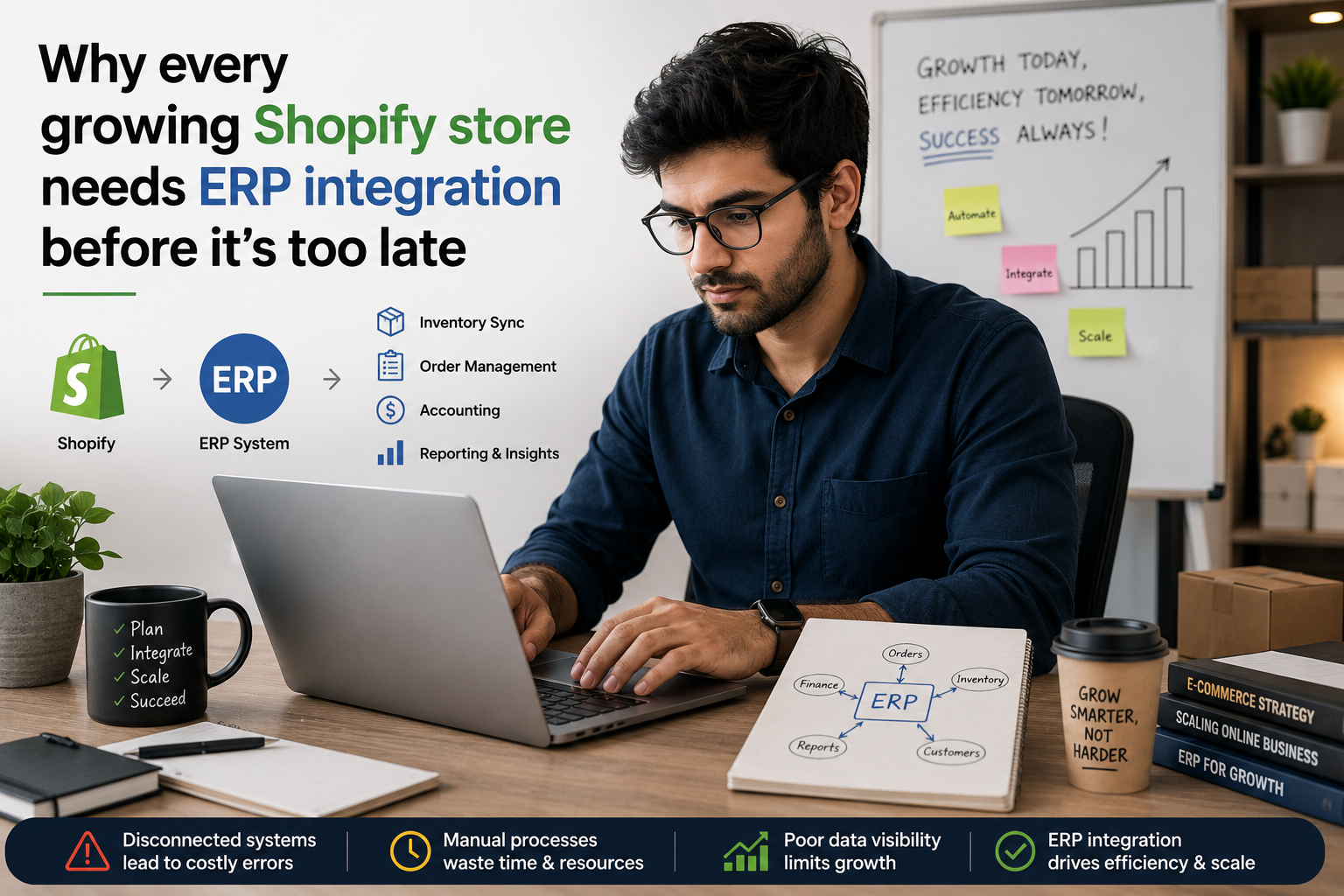
ERP integration is the moment a growing Shopify store stops managing data and starts running a business. It is not a technical luxury. It is the infrastructure that makes scaling without chaos possible.
How many hours a week does your team spend re-entering data?
We'll look at your current Shopify setup, map where the data gaps are, and show you what a proper ERP integration looks like for your specific systems. No pressure. Just a clear picture.
Book a free integration consultation →What Shopify does well and where it stops
Shopify is genuinely excellent at what it was designed for. It runs a fast, reliable storefront. It manages product listings, orders, and basic inventory counts. It processes payments, handles checkout, and gives your customers a smooth buying experience.
But Shopify was built for selling. It was not built to run a business.
It doesn't do double-entry accounting. It doesn't track cost of goods at the variant level. It doesn't manage purchase orders from suppliers or production BOMs for manufacturers. It doesn't give your accountant the financial reports they need for GST compliance. And when your business spans a retail store, a Shopify website, and a wholesale channel, Shopify has no way of showing you a real-time consolidated view of inventory across all three.
The five signs your Shopify store has outgrown manual processes
Someone's job is to copy orders from Shopify into Tally
If you have a person full-time or part-time whose primary task each day is exporting Shopify orders and re-entering them into your accounting system, you are paying a salary to do something software should do in seconds. That person's time has compounding cost: not just their salary, but every mistake they make, every hour of reconciliation those mistakes generate later, and every day that information is delayed reaching your accounts.
Your Shopify stock count and your physical count disagree
This is the "three-number problem", Shopify shows one figure, your warehouse count shows another, and your accounts show a third, all technically correct from their own vantage points but none of them trusted enough to make decisions from. When stock data lives in disconnected systems updated at different intervals by different people, the gap between what your website promises and what your warehouse can deliver grows silently until a customer orders something you can't fulfil.
You've had an oversell that caused a real customer problem
An oversell is the clearest possible signal that your inventory data isn't real-time. Two customers bought the last unit simultaneously, one from your Shopify store and one from a marketplace or wholesale order, because the systems didn't know about each other fast enough. Oversells damage customer trust in a way that's disproportionate to the actual problem. A customer who orders something and then gets told it's out of stock rarely gives you another chance.
Month-end reconciliation takes days, not hours
If your finance team dreads the end of the month because of what reconciliation involves matching Shopify revenue to Tally entries, chasing discrepancies, correcting errors from the previous month's manual entry that is the integration gap made visible in time. Every hour spent on reconciliation that shouldn't need to exist is an hour not spent on actual financial analysis and business decisions.
You can't answer "what's my real margin on this product?" quickly
Shopify knows what the product sold for. But it doesn't automatically know what it cost to produce, store, pick, pack, and ship. Without ERP integration pulling cost data alongside sales data, calculating true product margin requires manually pulling data from multiple systems and building it in a spreadsheet each time. That means most businesses don't look at it often enough and pricing decisions are made with incomplete information.
What changes when Shopify and your ERP are connected
Disconnected Shopify + ERP
- Orders exported daily, re-entered into Tally manually
- Inventory updated from spreadsheet always behind
- Month-end reconciliation: 3 days of painful matching
- Oversells happen when two channels sell the same stock
- Margin questions require a spreadsheet every time
Shopify + ERP integrated
- Order placed in Shopify → Tally updated within seconds
- Inventory reflects real stock across all channels, always
- Month-end reconciliation: automated matching, exceptions only
- Oversells impossible one shared inventory pool
- Margin visible on every product in real time
How Shopify ERP integration actually works
The core of any good Shopify ERP integration is a real-time, event-driven API connection not a scheduled sync that runs every 15 minutes.
The integration layer handles the data translation between Shopify's format and your ERP's format, maps product SKUs correctly between the two systems, and includes error handling with retry logic so a temporary ERP outage doesn't mean lost orders. Our apparel ERP integration service and accounting ERP integration are built on exactly this architecture.
The most commonly integrated systems alongside Shopify: Tally ERP 9 / TallyPrime for accounting and inventory, Zoho Inventory for multi-warehouse management, SAP Business One for enterprise operations, and custom warehouse management systems for businesses with bespoke fulfilment processes.
Lean Products transforming lean manufacturing with integrated eCommerce and ERP
Lean Products, a manufacturing and wholesale business, came to Satyanam with a fundamental problem: their eCommerce platform and their operational systems were completely disconnected. Orders had to be manually transferred into their ERP, inventory was always running slightly behind, and the customer and order management overhead was growing faster than the business. Satyanam built a modernised eCommerce platform with direct ERP integration connecting order management, large inventory tracking, and production operations into a single system. Customer and order data now flows automatically between the store and the ERP, giving the team a single accurate view of their operation without manual synchronisation work.
Read the full Lean Products case study →Ready to stop entering the same order three times?
Satyanam builds real-time ERP integrations for : Shopify, : nopCommerce, and WooCommerce: stores connecting Tally, SAP, Zoho, and custom systems. Let's map out what yours would look like.
Book a free strategy call →When is the right time to integrate and when is it already too late?
The honest answer is: most businesses integrate ERP later than they should, and they do it in response to a pain point that was building for months before anyone named it.
The right time is before your manual processes break under load not after they break and you're paying to unwind the mess.
Practical signals that it's time right now
- You have a team member whose primary job involves re-entering Shopify data into another system
- Your inventory count in Shopify regularly differs from your physical count by more than 2–3%
- You've had at least one oversell or stock discrepancy that caused a customer issue in the last 6 months
- Month-end reconciliation consistently takes more than a day
- You're adding a second sales channel marketplace, wholesale, or retail and have no plan for unified stock visibility
Also read: : How to build a custom nopCommerce API gateway →
Shopify scales your sales. ERP integration scales your operations. Without both working together, you eventually hit a ceiling where growth means more work, not more revenue and the extra work is going into tasks that should have been automated months ago.
The businesses that scale cleanly are not the ones with the most staff doing data entry. They're the ones whose systems talk to each other automatically, so their people can focus on the actual work of growing the business.
That transition has a starting point: a conversation about what you're currently running and what connecting it properly would look like. It's a short conversation. It almost always surfaces something useful.
Want to know what ERP integration would actually mean for your store?
We'll look at your current Shopify setup, your accounting system, and where the manual work is happening and give you a clear, honest view of what connecting them would take and what it would give you back. No obligation. Just the information you need to make the right call.
Get a free integration consultation →Frequently asked questions