
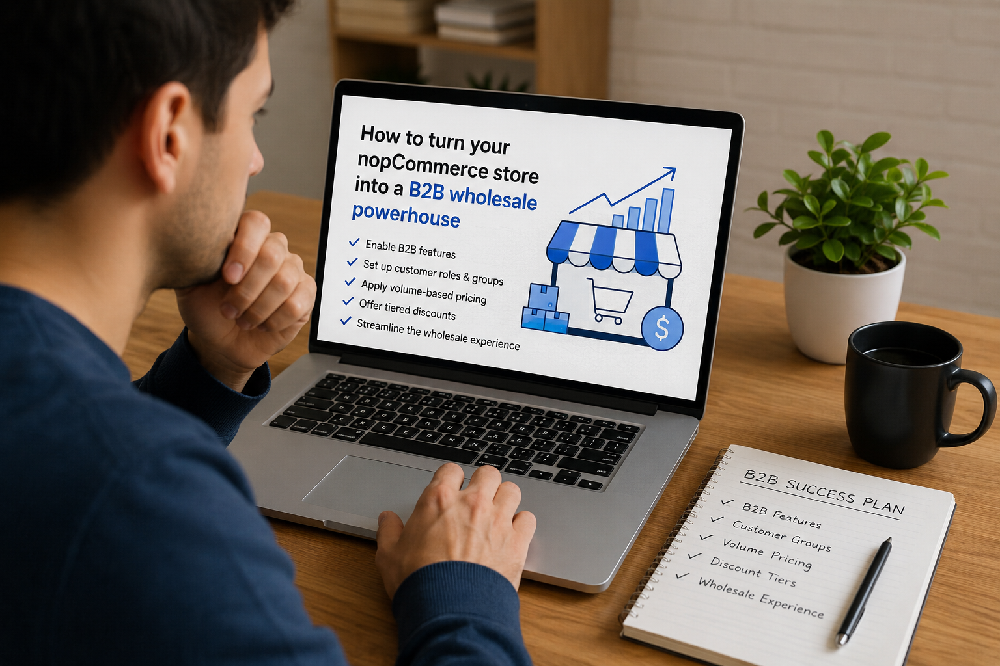
A wholesale buyer doesn't shop like a retail customer.
They're not browsing for inspiration. They already know what they want usually 40 units of one style in six colours and four sizes and they want to place that order in minutes, not by clicking through 24 individual product pages and adding each one to a cart separately.
If your nopCommerce store only knows how to sell one item at a time, at one fixed price, to a logged-out stranger, you're not really running a wholesale channel. You're running a retail store that wholesale buyers tolerate because they have no better option from you.
That gap between what wholesale buyers need and what most stores offer them is exactly where nopCommerce earns its reputation. Custom pricing, bulk ordering, and account-based catalogs aren't bolted-on features here. They're built into how the platform handles customers in the first place.
Already running wholesale through email and spreadsheets?
We'll show you what a proper nopCommerce wholesale portal looks like for your catalog custom pricing, bulk ordering, and account-based access. No cost to talk it through.
Book a free wholesale platform consultation →Why retail-built stores struggle with wholesale buyers
Most eCommerce platforms are designed around a single assumption: one customer, one product, one price, one quantity at a time. That works perfectly for someone buying a jacket for themselves. It breaks down almost immediately for a boutique owner placing a 200-unit seasonal order, or a regional distributor who needs pricing 30% below retail because of volume commitments.
When a store can't natively support that buyer, the order doesn't disappear it just moves offline. A phone call. An email thread. A manually typed quote. A spreadsheet sent back and forth for approval. Every one of those steps is a place where mistakes creep in, where orders get delayed, and where your team spends hours doing work the platform should be doing automatically.
Wholesale handled outside the platform
- Buyer emails asking for "the trade price list"
- Someone manually builds a quote in Excel
- Order confirmed by email, entered manually into the system
- Stock levels checked separately, sometimes after the fact
- No record of past orders the buyer can self-serve from
Wholesale built into nopCommerce
- Buyer logs in and sees their negotiated prices automatically
- Quick order form lets them enter SKUs and quantities in bulk
- Order syncs to ERP in real time stock and accounts stay accurate
- Order history and reorder buttons available to the buyer directly
- Your team only steps in for genuine exceptions
The three pillars of a working nopCommerce wholesale portal
Custom pricing through customer groups
nopCommerce lets you set up customer groups sometimes called customer roles and assign each one its own pricing rules. A "Wholesale Tier 1" group might see 25% off retail, while "Wholesale Tier 2" sees 35% off for higher-volume accounts. The same product catalog stays in one place, but the price a buyer sees depends entirely on who's logged in. You can also layer quantity-based discounts on top order 50 units of one style and the per-unit price drops automatically, no manual quote needed. This is configured through nopCommerce's built-in Discounts & Tier Pricing module, with no custom development required for standard setups.
Account-based catalogs that hide what shouldn't be seen
Not every wholesale buyer should see every product, and retail customers definitely shouldn't see your trade pricing. nopCommerce handles this through ACL (access control list) settings tied to customer groups and categories so a specific wholesale account can be restricted to only the product lines they're authorised to buy, while your retail catalog stays completely separate and visible to everyone else. For brands managing multiple sub-brands or regional distributor agreements, this is what makes it possible to run several distinct catalogs from a single admin panel without anyone seeing pricing or products meant for a different account.
Bulk ordering tools built for speed, not browsing
A wholesale buyer placing a large order shouldn't have to click into 40 separate product pages. nopCommerce supports a Quick Order Form where logged-in B2B customers can search the catalog, enter SKU and quantity directly in a grid, and add everything to cart in one screen. For buyers reordering the same mix every season, CSV and Excel upload options let them submit an entire purchase order in seconds by uploading a spreadsheet, rather than manually re-selecting every item. This single feature is often what convinces a wholesale buyer to actually use your portal instead of going back to email.
Why ERP integration matters more for wholesale than retail
A retail customer buying one item rarely notices a stock discrepancy. A wholesale buyer ordering 500 units absolutely will and if your store shows availability that your warehouse can't actually fulfil, that's a relationship problem, not just an inventory one.
nopCommerce connects directly to systems like Tally, SAP, and Zoho through API-level integration rather than relying on a third-party sync app that runs on a delay. One Satyanam client recovered 40 hours of staff time every week simply by removing the manual reconciliation step between their wholesale orders and their accounting system time that went straight back into managing actual customer relationships instead of spreadsheets.
What a proper wholesale portal did for one apparel brand
An apparel brand running both retail and wholesale through the same store came to Satyanam managing wholesale orders almost entirely by hand emails, manually built quotes, and a separate spreadsheet tracking which buyers had which pricing agreement. As the wholesale side grew, the manual process grew with it, and so did the mistakes.
| Area | Before | After |
|---|---|---|
| Wholesale pricing | Manually quoted per buyer, inconsistent | Automatic via customer groups, consistent every time |
| Placing a large order | Email, then manual entry by staff | Buyer self-serves via Quick Order Form |
| Stock accuracy | Checked manually, sometimes stale | Live ERP sync, always current |
| Multi-brand management | Separate spreadsheets per sub-brand | 3 sub-brands, one admin, zero crossover |
| Support load | High pricing and stock questions | Down 44% once buyers could self-serve |
What made the difference
- Customer group pricing removed the need for a human to quote every single order
- The Quick Order Form gave buyers a way to place large, repeat orders without staff involvement
- Direct ERP integration meant the storefront and the warehouse always agreed on stock
- Account-based catalogs let three sub-brands share infrastructure without sharing data
Apparel brand: A nopCommerce wholesale rebuild that unlocked $280K in new monthly GMV
This apparel brand needed retail and wholesale to run from the same product catalog without the two channels interfering with each other. Satyanam built customer-group-based pricing for wholesale tiers, an account-based catalog so each sub-brand and buyer group saw only what applied to them, a bulk order form for repeat wholesale buyers, and a live Tally ERP integration to keep stock accurate across every channel.
Ready to give your wholesale buyers a real portal?
Satyanam builds custom nopCommerce wholesale portals customer group pricing, account-based catalogs, bulk order tools, and ERP integration for apparel and fashion brands managing complex B2B relationships.
Book a free nopCommerce consultation →Where to start if wholesale is still mostly manual today
You don't need to rebuild everything at once. The brands that move fastest usually start with whichever piece is causing the most pain right now.
If pricing disputes are the problem
Start with customer groups and tiered pricing. This alone removes the most common source of friction a buyer questioning why they were quoted differently than last time. Once pricing is automatic and consistent, that conversation disappears.
If staff time on order entry is the problem
Start with the Quick Order Form and bulk upload tools. Getting buyers to place their own orders directly is usually the single biggest time recovery available, especially for accounts that reorder the same mix repeatedly.
If stock mistakes are the problem
Start with ERP integration. Nothing damages a wholesale relationship faster than confirming an order the warehouse can't actually fulfil. Getting your storefront and your accounting system to agree, in real time, fixes this at the source.
Also read: How to build a custom nopCommerce API gateway →
Wholesale buyers don't want a nicer version of your retail store. They want a fast, accurate way to place large, repeat orders without a back-and-forth that wastes everyone's time.
nopCommerce was built with the flexibility to handle that custom pricing through customer groups, account-based catalogs that show the right buyer the right products, bulk ordering tools that respect how wholesale buyers actually shop, and ERP integration that keeps everyone working from the same numbers.
None of this requires guessing. It requires building the platform around how your wholesale customers actually operate, instead of asking them to work around a store that was never built for them.
Get your free nopCommerce wholesale consultation
Tell us how wholesale works for you today even if it's mostly spreadsheets and email and we'll show you exactly what a proper nopCommerce wholesale portal would look like for your catalog.
Get your free Shopify CRO audit →Frequently asked questions