
Most Shopify store owners reach a specific, frustrating moment at some point in their growth. The store is working traffic is coming in, some orders are converting, the platform is stable. But there's something the business needs to do that Shopify simply won't let it do cleanly.
A customer wants to personalise a product with custom text and Shopify's variant system can't handle it. A wholesale buyer needs pricing that reflects their volume agreement and there's no clean way to show it. The team is manually exporting orders every morning because the store doesn't talk to the accounting system.
None of these are catastrophic failures. Each one looks like a manageable workaround when it first appears. But workarounds compound. And after a year of living with half a dozen of them, the operational overhead is real and the customer experience has visible gaps.
These are solvable problems, not with more apps, but with custom development that builds what Shopify doesn't provide out of the box. Here are six of the most common ones, with real client examples for each.
Running into Shopify's limits right now?
We'll look at the specific thing your store can't do and tell you honestly whether custom development is the right fix and what it would involve. No proposal, no pressure.
Book a free consultation →Six custom Shopify features that solve real business problems
Custom product options and personalisation
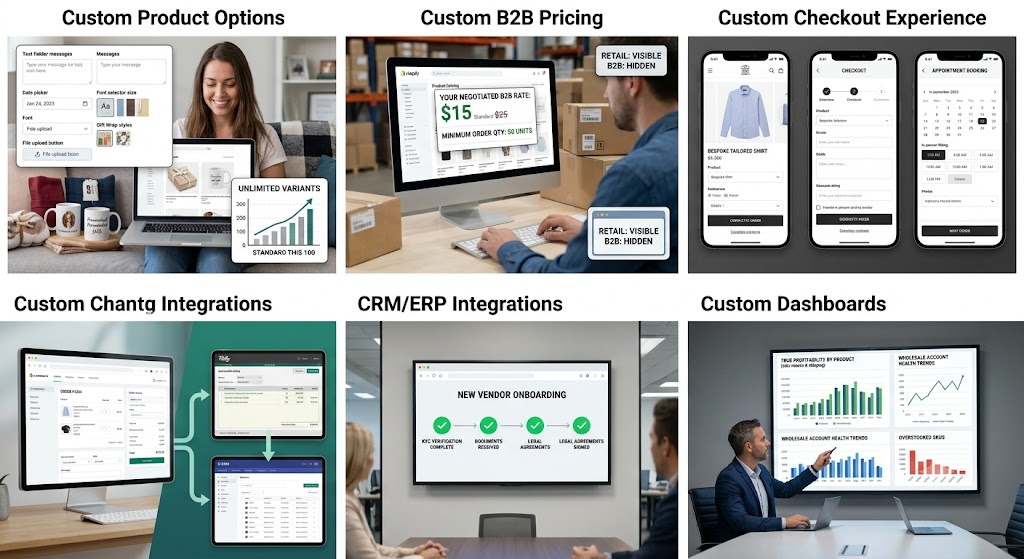
The pain point: Shopify's default product system allows a maximum of three option types usually size, colour, and material and caps out at 100 variants per product. That sounds generous until you're running a gift brand where customers want to add a personalised message, upload a photo, choose a font, select a gift wrap style, and specify a delivery date. Shopify can't natively handle that combination. Stores that try to force it usually end up with a messy workaround using notes fields, which creates manual fulfilment work and a confusing customer experience.
What custom development does: removes the variant cap entirely and adds any input type you need text fields, file uploads, date pickers, image selectors, conditional options that change based on earlier selections. Price adjustments are applied in real time based on what the customer chooses. The personalisation data travels with the order to fulfilment so nothing falls through the cracks.
Real example: Giftush, a personalised gift marketplace Satyanam built, needed a product experience where customers could build completely custom gift combinations, selecting vendors, personalising individual items, and adding messages all within a single, coherent buying flow. A standard Shopify product structure couldn't accommodate it. The custom product system built for Giftush let buyers configure their order progressively, with each selection updating price and availability in real time, in a way that felt simple to the customer despite being complex underneath.
Read the Giftush case study →Custom pricing, discounts, and B2B pricing tiers
The pain point: Shopify's pricing model is fundamentally single-tier. One price, visible to everyone. If you sell to both retail customers and wholesale buyers with different prices, minimum order quantities, or volume-based discounts the standard platform has no clean answer for this. Apps exist, but they add cost, create performance overhead, and often conflict with each other or with your theme. And none of them give you the flexibility to build the specific pricing logic your business actually uses.
What custom development does: builds customer-group pricing directly into your store's logic. Wholesale buyers log in and see their negotiated rates. Retail customers see standard pricing. Volume discounts apply automatically at the correct thresholds. Custom minimum order quantities are enforced per account. All of this is baked into the store not bolted on through a third-party app that may or may not work next time Shopify updates.
Real example: Unique Batik, a fair trade wholesaler selling accessories and apparel, needed their store to serve both retail and wholesale buyers without maintaining two separate storefronts. Satyanam built a custom wholesale management system where approved trade buyers see a completely different pricing layer once authenticated, different prices, different minimum quantities, different checkout rules while the retail experience stays intact for everyone else. Lola Jeans, a women's apparel manufacturer selling across multiple countries, had a similar need: each market had different pricing agreements, and the standard Shopify multi-currency setup didn't account for that complexity. A custom pricing layer solved both.
Read the Unique Batik case study →Custom checkout and buying experience
The pain point: Shopify's checkout is reliable and well-designed for standard retail purchases. But the moment your business has a non-standard buying journey appointment booking alongside a product purchase, a multi-step configuration flow, a specific upsell at a specific moment, a checkout that behaves differently for wholesale versus retail the standard checkout becomes a constraint rather than a tool. You either find an app that gets you 80% of the way there, or you accept that the checkout doesn't work quite the way the business needs.
What custom development does: builds the specific checkout experience your customers and business model require. That might mean a hybrid store that sells physical and digital products through the same cart with different fulfilment paths. It might mean integrating a booking system into the checkout so a customer can purchase and schedule in one session. It might mean a conditional upsell that only appears for specific product combinations.
Real example: Arthur Montreal, a bespoke apparel brand, needed customers to be able to book an in-person fitting appointment at the same time as completing a product order a checkout experience that doesn't exist natively in Shopify. Satyanam built a custom checkout integration that combined the product purchase and appointment scheduling into a single, coherent flow. Wildly Bookish, a children's publisher, needed digital and physical book purchases to fulfil through completely different paths from the same cart digital books via instant download, physical books via shipping without requiring customers to manage two separate checkouts.
Read the Arthur Montreal case study →Custom Shopify integrations with CRM, ERP, and other systems
The pain point: Shopify operates in isolation from almost every other system a growing business depends on. Orders come in, and then someone manually exports them to Tally. Stock gets updated in the ERP, and then someone manually updates Shopify. Customer purchase data sits in Shopify while the CRM has a different, older record of the same customer. Every time data crosses that gap manually, there's delay, and there's risk of error. For businesses processing more than 30–50 orders a day, this overhead is genuinely significant.
What custom development does: builds a real-time, event-driven API connection between Shopify and your external systems. An order placed on Shopify creates an accounting entry in Tally within seconds. A purchase updates the customer's CRM record automatically. A stock receipt in the warehouse pushes back to Shopify so the store always shows real availability. There's no export, no manual entry, no delay, and no discrepancy between what different systems believe to be true.
Real example: Northern, a customised apparel manufacturer, was spending significant staff time each week manually transferring data between their eCommerce store, their Tally accounting system, and their production operations because none of these talked to each other. Satyanam built a full ERP integration that connected all three in real time. The same approach was applied for Lean Products, a lean manufacturing business where order management, inventory, and production operations needed to reflect each other accurately to make the business function correctly at scale.
Read the Northern case study →Custom automation to reduce manual work
The pain point: Shopify Flow exists and is genuinely useful for simple automations tagging orders, sending basic notifications, applying discounts based on conditions. But it has real limits for businesses with more complex operational needs. Onboarding a new vendor to a marketplace requires verification steps, document collection, legal agreement acceptance, and account setup a sequence that Shopify Flow was not designed to handle. Triggering a logistics booking automatically when specific order conditions are met is beyond what standard automation tools can do cleanly.
What custom development does: builds the specific automation logic your operation needs, triggered by the right events, with the right conditional logic, and connected to the right external systems. This is different from a general automation tool it's built for your exact workflow and maintains itself without manual intervention at every step.
Real example: All MIB, India's first Made-in-Bharat marketplace for artisans and MSME makers that Satyanam built on Shopify and Webkul, required a zero-touch vendor onboarding flow. When a new seller applied, the system had to verify their identity through KYC integration, collect their business documents, present click-wrap legal agreements, set up their membership billing, and configure their store access automatically, without any manual intervention from the marketplace team. That level of conditional, multi-step automation required custom development that Shopify Flow alone could not have handled. Needly, a grocery and food delivery platform, had similar automation requirements for order routing, delivery slot management, and logistics dispatch all of which needed to trigger and complete without manual steps in a time-sensitive delivery context.
Read the All MIB case study →Custom dashboards, reports, and business workflows
The pain point: Shopify's built-in analytics are useful for surface-level questions, total sales, sessions, conversion rate. But they stop well short of what a growing business actually needs to make good decisions. Which products are genuinely profitable after returns and shipping costs? Which wholesale accounts are trending down in order frequency? Which SKUs are overstocked relative to current sell-through rate? Answering these questions in Shopify typically requires exporting data to Excel and building it manually every time someone needs it. That's a process that works fine once. It doesn't scale.
What custom development does: builds a reporting and dashboard layer that surfaces the metrics your specific business actually needs, in real time, without requiring anyone to export and rebuild a spreadsheet. This might be a production operations dashboard showing orders at each stage of manufacturing. It might be a wholesale account health report that flags accounts by order frequency and average value. It might be a margin report that pulls cost data from the ERP alongside Shopify revenue data to show true profitability by product and category.
Real example: Northern needed a production operations management layer not just a sales dashboard, but a view that connected customer orders to manufacturing stages, so the operations team could see at a glance what was being made, what was waiting on materials, and what was ready to ship. Speed Industry, an automobile eCommerce retailer whose platform Satyanam modernised, needed a custom reporting layer that connected their migrated platform data with their existing business intelligence needs because the standard reports on their new platform didn't reflect how the business measured its own performance.
Read the Northern case study →Recognise your store in any of these?
Satyanam builds custom Shopify development solutions for the gaps the platform doesn't fill natively product options, pricing logic, checkout flows, integrations, automation, and reporting. Let's talk about what your store specifically needs.
Book a free strategy call →How to decide which one to fix first
If you've identified more than one of these gaps in your store which most growing businesses do the question is where to start. The answer is almost always the gap that's costing the most business value right now.
Shopify is genuinely one of the best platforms available for launching and running an eCommerce store. The limitations described in this article aren't criticisms of the platform they're honest observations about where its defaults stop matching the needs of businesses that have grown beyond a straightforward retail operation.
The good news is that almost every limitation described here has a custom development solution that works within or alongside Shopify's architecture. You don't necessarily need to migrate platforms. You need the specific capability your business needs, built properly, integrated cleanly.
The gap between "what Shopify does by default" and "what your store actually needs" is almost always smaller than it looks and the business value of closing it is usually larger than the cost of building it.
Tell us which limitation is costing your store the most
Satyanam has built custom product options, B2B pricing systems, checkout integrations, ERP connections, automation workflows, and reporting dashboards for Shopify stores across apparel, gifts, jewellery, manufacturing, education, and marketplace businesses. If one of the six features in this article describes a problem you're living with, we'd be happy to talk through what solving it would actually involve.
Get a free custom Shopify consultation →Frequently asked questions